Work & Productivity·March 17, 2026
Answer 'Will I Qualify?' in Seconds, Not Hours
TL;DR
Clients want to know if they'll qualify for a mortgage. The answer is buried in 80 pages of underwriting. Here's the broker's playbook to find it in seconds.
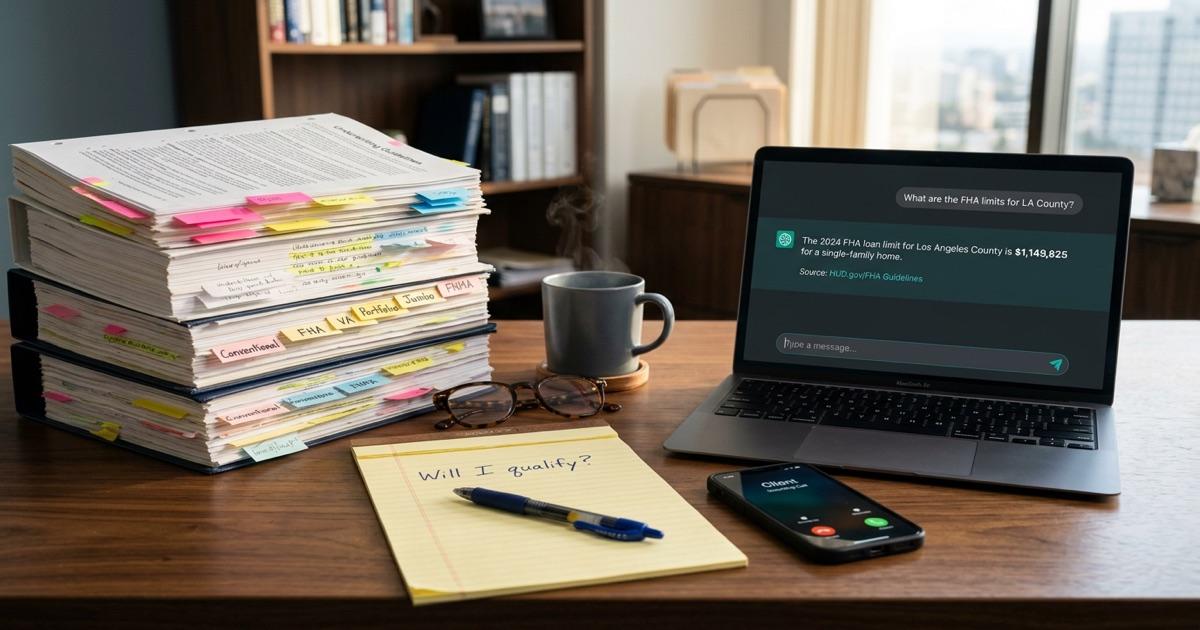
"Will I qualify?"
That's the one question. Every client asks it. It's the first thing out of their mouth, and they want an answer now. Not after you call the underwriter. Not after you check three lender portals. Now.
The problem is that "Will I qualify?" lives in eighty pages of underwriting guidelines. Not one document. Every lender you work with has their own stack. FHA is one pile. Fannie is another. Your favorite wholesale partner has three more. You have shelves of binders or folders full of PDFs, and the real answer to the client's simple question is somewhere in paragraph four of page fifty-seven.
Here is what actually works.
The move: stop flipping pages
Nobody is paying you to remember eighty pages. Nobody cares that you can. Clients are paying you to get to a clear yes, no, or maybe in the shortest time possible, ideally in language they can repeat to their spouse later. The brokers who grow their book of business are not the ones with the best memory for guidelines. They are the ones who can look a client in the eye inside two minutes and say "yes, here is why."
The rest is workflow.
The playbook
Once: train it on your guidelines (15 min, one time)
Open CorpGPT. Drop in every underwriting guide you actually reference. FHA. VA. Fannie. Freddie. Each wholesale lender. Every non-QM program you quote. Upload them all.
This is a one-time setup. From this point forward, every guideline question you are ever going to have lives in one place. Tag them by lender name so you can filter later if you want.
On every call: ask in plain English
Client says: "I had a short sale three years ago, can I still get a conventional loan?"
You type into CorpGPT: "Fannie Mae conventional after short sale, seasoning requirement and exceptions."
Ten seconds later you have the answer, with the exact page number it came from. No flipping. No tab-switching. No "let me get back to you."
Read the answer on the screen. Restate it in plain English to the client. Cite the page if they want to see it for themselves.
For the tricky cases: ask follow-ups
Not every question has a clean yes or no. The interesting ones rarely do. Self-employed with two years of tax returns but one year showing a loss. New construction with an appraisal gap. 1099 income plus W-2 income from the same employer. A gift fund from a non-occupying family member.
Ask CorpGPT follow-ups in the same conversation. Each one stays grounded in the same guidelines you uploaded. You do not have to re-paste, re-explain, re-upload. It remembers the previous turn.
When a guideline is ambiguous, you still pick up the phone and call your AE. The difference is you call with the exact question and the exact page, not with a vague "can we do this?" Your AE respects that. So does the client.
Why this actually works
Three forces are doing the real work.
First, plain English beats keyword search. You are not scanning a PDF for the word "seasoning." You are asking the guideline document a question and getting an answer. The mental load drops from "find the rule" to "understand the rule."
Second, citations matter. CorpGPT tells you exactly which page the answer came from. You can open the source and show the client. You are not guessing. The client is not guessing. Nobody gets a surprise decline two weeks into underwriting.
Third, speed compounds. The average guideline lookup that used to take five to ten minutes between calls takes ten seconds now. Across a week that is hours back. Across a year that is how you build a referral business, because you are the broker who answers on the first call instead of the one who says "let me get back to you."
What it can't do
Be honest about this. CorpGPT does not underwrite the loan. It does not replace a DU or LP run. It does not make the exception call for you when the lender has to weigh a borderline file.
What it does is make you fast at the first-pass question, so you pre-qualify clients in minutes instead of days. The exception calls still happen. They just happen on loans that are actually going to close, instead of loans where you wasted a week discovering a deal-breaker on page sixty-three.
The bottom line
Every client asks "Will I qualify?" and the good ones pay for a quick answer.
Close loans faster. Explain it to Grandma. Get the referral.
Open CorpGPT. Drop in your guidelines. Take the next call with confidence.
Keep reading
- Your Client Wants 30 Listings by Saturday — the same playbook, but for a real estate agent buried in 30 disclosure PDFs.
- Cram 400 Pages Before Morning — how students use CorpGPT to survive an exam they forgot about.
- Doctors: Stop Charting After Hours — how physicians finish documentation before lunch instead of after dinner.
- 200-Page Contract at 4:45 on a Friday — how lawyers catch every trap in a weekend ambush and still make it to dinner.
- Turn One Chapter Into a Week of Lessons — how teachers build a full week of materials from a single source chapter in one evening.
- Tax Code Changed. Again. — how accountants translate new tax rules into client-ready answers with citations in seconds.
- Two Minutes Before the Client Call — how financial advisors sound sharp on every unscheduled portfolio call with cited research.
- Claim Denied. Find the Clause. — how insurance agents pinpoint the exact exclusion in an 80-page policy and win the callback.
- Beat the Binder: The Nurse's 12-Hour Shift Playbook — how nurses turn hospital formularies and protocol binders into instant cited answers at the bedside.
- Ten Minutes Between Sessions — how therapists keep their clinical library, CE, and psychoeducation handouts one prompt away.
- It's 9 PM and You're Not a Lawyer — how small business owners review vendor contracts, catch red flags, and sign smart without a legal team.
- Client Deck Tomorrow. It's 8 PM. — how consultants synthesize four reports into a draft deck and pressure-test the story before midnight.
- Another Meeting to Recap the Last Meeting — how project managers record meetings and ship the summary, decisions, and action items in two minutes.
- Answer Once. Help Forever. — how HR managers turn the handbook into a self-serve, cited-answer assistant and finally take a lunch break.
- 200 Resumes. One Hour. — how recruiters surface signal from a 200-resume pile and walk into the hiring manager intake actually prepared.
- How Are You Different From [Competitor]? — how sales reps get instant cited battlecard answers mid-call and do the follow-up in five minutes.
- Brand Says Bold. Legal Says Careful. — how marketing managers ship campaigns on time with brand and legal both signed off.
- Seventeen Transcripts. One Deadline. — how writers turn a pile of interview transcripts into themes, pulled quotes, and a working outline.
- Ninety-Minute Interview. Show Notes by Tuesday. — how indie podcasters ship the entire post-production package from one upload.
- Sixty Videos In. Did I Already Post This? — how content creators turn their back catalog into a searchable content brain.
- Sixty Papers. One Lit Review. One Weekend. — how researchers turn a stack of PDFs into summaries, themes, citations, and gaps.
- Three Investor Meetings. Three Different Decks. — how founders tailor a pitch per investor.
- 47-Page Brief. Proposal Due Friday. — how freelancers turn dense briefs into proposals in hours.
- Your Kid Just Asked About Algebra. — how parents help with homework using the actual textbook.
- Medicare Sent a Letter. 12 Pages. Tiny Font. — how older adults turn any letter into a plain-English one-pager.
- See all use cases — brokers, agents, students, teachers, lawyers, doctors, and more.
- Plans & pricing — free tier included, no credit card required.