Study Tips·April 18, 2026
Cram 400 Pages Before Morning: The Midnight Exam Playbook
TL;DR
Exam at 8 AM. Textbook at 400 pages. You never started. Here's the student's playbook to actually pass — from midnight to alarm — and remember it tomorrow.
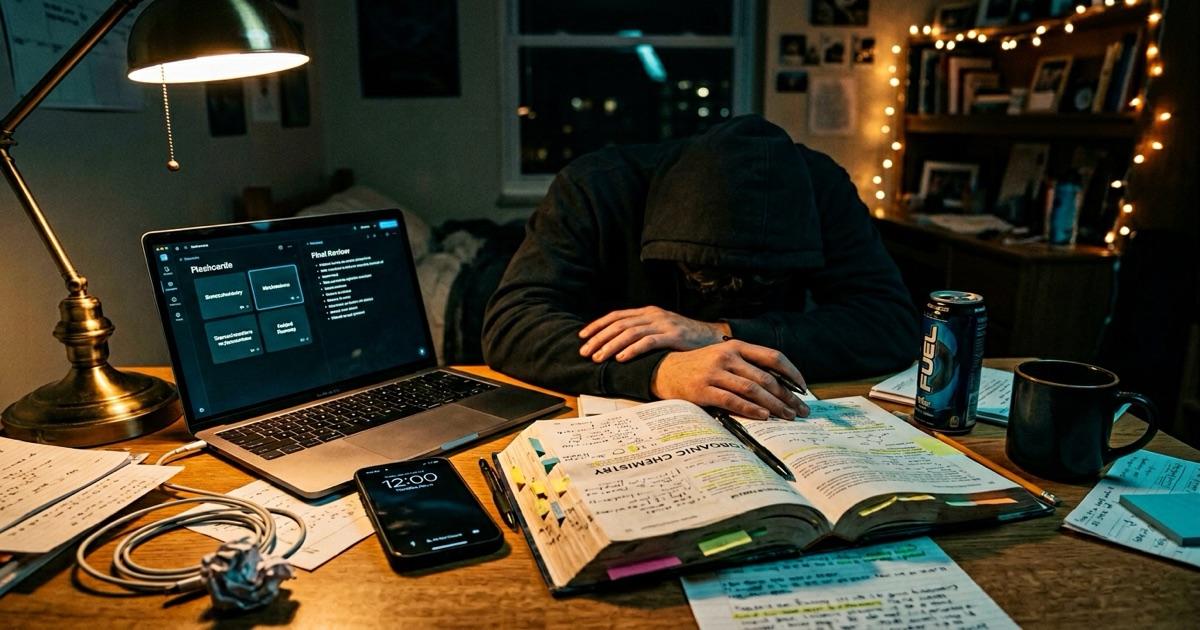
It's midnight. Your exam's at 8 AM. Your textbook has 400 pages.
You didn't plan on this. You were going to start last week. Then last weekend. Then yesterday. Now it's midnight and the textbook is as unread as the day you bought it.
Every piece of advice you're going to find right now is useless. "You should have started earlier." Obviously. "Get a good night's sleep." Can't. "Prioritize your health." The exam won't.
Here's what actually works. A minute-by-minute playbook that respects how bad the situation is and gets you to a passing grade by 8 AM.
The core move: stop trying to read it
The mistake tonight is trying to read 400 pages. Every panicked student makes it. You can't. Nobody can. Not with coffee, not with willpower, not with a nootropic your roommate gave you.
What you can do is extract the parts that matter, quiz yourself on them until they stick, and sleep for four hours. That's the whole play. Everything below is execution.
The 6-hour plan
11:00 PM. Upload everything (2 min)
Open CorpGPT. Drop in your textbook PDF. If you have lecture slides, the syllabus, a study guide, or a friend's notes, drop those in too. More sources means better questions.
While it processes, brew coffee. Clear your desk. Put your phone face-down. The scroll is the enemy.
11:05 PM. Get the map (15 min)
Ask CorpGPT to build a study guide. You get back the whole textbook compressed into a chapter-by-chapter summary, the key concepts with definitions, and the stuff professors actually test on instead of the filler.
Read it. Ten minutes tops. This is your map of the territory. You're not memorizing yet. You're figuring out where the mountains are.
11:20 PM. Quiz yourself and find the weak spots (90 min)
Generate a Quiz. Thirty to fifty questions from the source material.
Take it. Don't skip the hard ones. The questions you get wrong, those chapters are where you'll spend the next hour.
This is the step every generic how-to-study article gets wrong. They tell you to re-read your notes. Re-reading doesn't work. It tricks your brain into feeling familiar with the material without actually knowing it. You close the book confident. You open the exam blank.
Being forced to produce the answer from memory is what actually builds the neural path. That's active recall. The quiz is active recall. Re-reading isn't.
12:50 AM. Flashcards for what you missed (45 min)
For every question you got wrong, generate Flashcards. CorpGPT builds the whole deck from your textbook. You don't handwrite a single one.
Now cycle through the deck. Flip, try to remember, flip, move on. Don't dwell. Five fast passes in 45 minutes beat two careful passes every time.
1:35 AM. Mind map the chapters (15 min)
Ask CorpGPT for a Mind Map. This is the thing professors keep hinting at when they say "connect the concepts." How does chapter 3 relate to chapter 7? Why are we reading this section at all? The mind map answers that in one look.
Fifteen minutes on your phone while lying in bed works fine.
1:50 AM. Sleep. Seriously.
Four hours. Set two alarms. One on your phone, one across the room.
Your brain consolidates memory during sleep. The studying you just did gets re-filed from fragile short-term storage into something more stable. If you stay up instead, you'll remember less at 8 AM than if you'd gone to bed. Sleep is not a luxury. It's part of the plan.
6:00 AM. Flashcards on the way to the exam
Alarm. Shower. Coffee. Open the flashcard deck on your phone.
On the walk, the ride, the coffee line, flip through. Don't try to learn anything new. Just reinforce the paths you built last night. You want the material actively loaded when you walk in, not three-hours-dead from 2 AM memorization.
Why this actually works
Three forces are doing the real work.
First, active recall beats re-reading. Every quiz question forces retrieval. Retrieval is what builds memory. Reading the same page five times builds familiarity, which feels the same and is nothing like it.
Second, targeted weakness. You don't have time to study everything evenly. Study exactly what you got wrong. Let what you already know slide.
Third, sleep and morning review. Your brain consolidates while you sleep. Morning flashcards rebuild the retrieval paths right before you need them. You arrive warm, not exhausted.
This isn't magic. It's how memory actually works. You're just using tools that handle the mechanics so you can focus on the retrieving, which is the only part that can't be automated.
What this playbook can't do
Be honest with yourself about what kind of exam this is.
If it's multiple choice, short answer, or fact recall, you're set. This playbook is built for this.
If it's an essay exam, different animal. Ask CorpGPT to generate five likely essay questions from your material and outline three of them. You'll walk in with patterns pre-rehearsed, which is eighty percent of the essay-writing battle.
If it's a problem set (math, physics, coding), you need practice problems, not flashcards. Work the end-of-chapter problems cold. When you get stuck, CorpGPT will explain where you went wrong.
The bottom line
You were supposed to study last week. You didn't. It's fine. The world did not end.
What you have now is six hours, a phone, a textbook you haven't opened, and a plan that respects how bad the situation is. Most of the plan is automated. CorpGPT builds the study guide, the quiz, the flashcards, the mind map. The human parts that can't be shortcut (the sitting, the flipping, the sleeping) are the only parts left.
Close this tab. Open CorpGPT. Drop in your textbook. It's 11 PM somewhere.
Your roommate will think you're magic.
Keep reading
- Your Client Wants 30 Listings by Saturday — the same playbook, but for a real estate agent buried in disclosure PDFs.
- Answer 'Will I Qualify?' in Seconds — how mortgage brokers use CorpGPT to answer clients on the first call.
- Doctors: Stop Charting After Hours — how physicians finish documentation before lunch instead of after dinner.
- 200-Page Contract at 4:45 on a Friday — how lawyers catch every trap in a weekend ambush and still make it to dinner.
- Turn One Chapter Into a Week of Lessons — how teachers build a full week of materials from a single source chapter in one evening.
- Tax Code Changed. Again. — how accountants translate new tax rules into client-ready answers with citations in seconds.
- Two Minutes Before the Client Call — how financial advisors sound sharp on every unscheduled portfolio call with cited research.
- Claim Denied. Find the Clause. — how insurance agents pinpoint the exact exclusion in an 80-page policy and win the callback.
- Beat the Binder: The Nurse's 12-Hour Shift Playbook — how nurses turn hospital formularies and protocol binders into instant cited answers at the bedside.
- Ten Minutes Between Sessions — how therapists keep their clinical library, CE, and psychoeducation handouts one prompt away.
- It's 9 PM and You're Not a Lawyer — how small business owners review vendor contracts, catch red flags, and sign smart without a legal team.
- Client Deck Tomorrow. It's 8 PM. — how consultants synthesize four reports into a draft deck and pressure-test the story before midnight.
- Another Meeting to Recap the Last Meeting — how project managers record meetings and ship the summary, decisions, and action items in two minutes.
- Answer Once. Help Forever. — how HR managers turn the handbook into a self-serve, cited-answer assistant and finally take a lunch break.
- 200 Resumes. One Hour. — how recruiters surface signal from a 200-resume pile and walk into the hiring manager intake actually prepared.
- How Are You Different From [Competitor]? — how sales reps get instant cited battlecard answers mid-call and do the follow-up in five minutes.
- Brand Says Bold. Legal Says Careful. — how marketing managers ship campaigns on time with brand and legal both signed off.
- Seventeen Transcripts. One Deadline. — how writers turn a pile of interview transcripts into themes, pulled quotes, and a working outline.
- Ninety-Minute Interview. Show Notes by Tuesday. — how indie podcasters ship the entire post-production package from one upload.
- Sixty Videos In. Did I Already Post This? — how content creators turn their back catalog into a searchable content brain.
- Sixty Papers. One Lit Review. One Weekend. — how researchers turn a stack of PDFs into summaries, themes, citations, and gaps.
- Three Investor Meetings. Three Different Decks. — how founders tailor a pitch per investor.
- 47-Page Brief. Proposal Due Friday. — how freelancers turn dense briefs into proposals in hours.
- Your Kid Just Asked About Algebra. — how parents help with homework using the actual textbook.
- Medicare Sent a Letter. 12 Pages. Tiny Font. — how older adults turn any letter into a plain-English one-pager.
- AI flashcard maker — turn any textbook or PDF into flashcards automatically.
- AI quiz generator — practice quizzes from the exact pages your exam covers.
- Chat with PDF — ask any document questions and get answers cited to the page.
- See all use cases — students, teachers, lawyers, doctors, brokers, agents, and more.
- Plans & pricing — free tier included, no credit card required.