Business·February 6, 2026
Three Investor Meetings. Three Different Decks. The Founder's Playbook.
TL;DR
Three investors this week, three different theses, one of you. Here's the founder's playbook to tailor a pitch per investor without rewriting the whole deck.
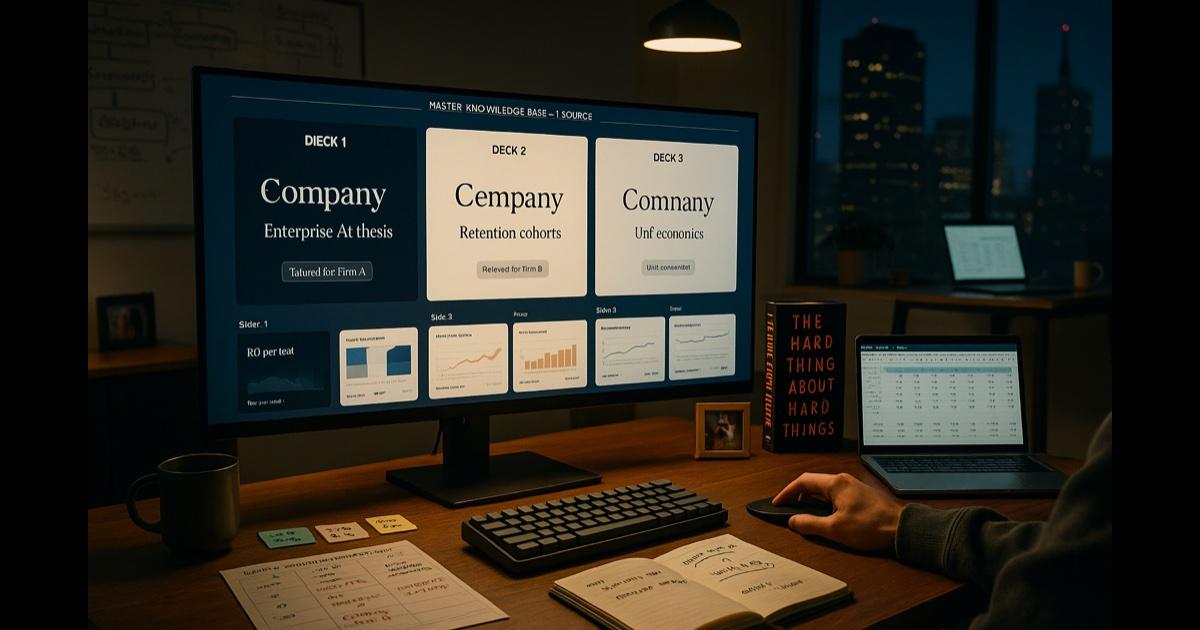
It is Sunday night. On your desk: a master deck that worked for the last two meetings. In your calendar for the week: three investor meetings with three firms whose theses don't overlap. One is an enterprise-AI specialist who wants to see ROI per seat. One is a consumer-ish fund that wants to see usage curves and retention cohorts. One is a generalist who wants to see a founder who understands the business model, not just the product.
You cannot walk the same deck into all three rooms. You also cannot rebuild it from scratch three times. You have a board deck Wednesday, a customer call Thursday morning, and — at some point this week — a life.
This is the founder's specific tax. The pitch is the same story; the emphasis is the whole game. And you are the only one who can decide the emphasis. But you are not the only one who has to build the slides.
The move: one master Knowledge Base, three tailored decks
Keep your thinking in one place. Let the tool produce three first-draft decks from it — one per investor thesis — and spend your time on the edits that actually matter.
The playbook
Sunday night: build the founder's Knowledge Base (90 min, once)
Open CorpGPT. Create "[Company] — Fundraising." Load:
- Your master deck (the one you've been iterating for months).
- Your financial model and unit economics one-pager.
- Your product one-pager, roadmap, demo script.
- Customer interview notes and the 5-10 best anonymized quotes.
- Competitive landscape notes — who you win against, who you lose to, why.
- Your prior investor meeting transcripts (via Live Recording, with consent).
- Every investor rejection note you've written — it's a goldmine of the weak spots in your pitch.
- Each target investor's public thesis, portfolio, recent deal announcements, and partner bios.
Ninety minutes. Your fundraising corpus is now queryable — you can chat with your research and ask across every doc at once, instead of digging through files one by one.
Monday morning: generate three tailored decks (45 min)
Open Knowledge Studio. For each of the three investors, generate:
- A cover/positioning slide that uses language from their public thesis.
- A "why now" slide framed against trends the firm has written about publicly.
- A comparables slide that references companies in their portfolio (without being creepy about it).
- A section re-ordering proposal — which slides to lead with, which to cut, which to make optional appendix.
Same numbers. Same product. Different frames. Let it build the slides straight from your materials, then output a side-by-side of all three so you can see the differences at a glance.
Monday afternoon: the hostile-Q&A drill (30 min per investor)
Ask Nova:
- "Given [Firm]'s public thesis and portfolio, what are the five hardest questions a partner there is likely to ask me? Draft my one-paragraph answer with citations to my own materials."
- "What's the single biggest weakness in my pitch for this specific firm? Where have I been weakest in prior investor meetings when asked similar questions?"
- "Which of my customer quotes would land hardest with a firm like this? Which would read as noise?"
Fifteen questions, three investors, forty-five minutes. You now walk in with the hard questions already answered in your voice.
Before each meeting: the two-minute refresher
Ask Nova, 10 minutes before the call: "Give me a two-minute briefing on [Firm] — partner's recent public statements, portfolio companies relevant to our space, the specific angle they've praised and the one they've been skeptical about."
You sound like you did your homework because you did, just faster than your competitors did.
After each meeting: ship the follow-up in 20 minutes, not 3 days
Live Recording captures the call (with consent). Knowledge Studio produces a tailored follow-up email — with the specific clarifications they asked for, the data points they pushed on, and two or three answers to questions you punted on. The investor gets your follow-up same-day. Most founders take three days. You are the one they call back first.
Beyond fundraising
Board decks
Same Knowledge Base, quarterly board decks generate themselves. Ask Knowledge Studio for a board update in the voice of your prior three decks. Edit. Ship.
Hiring
The "why join us" pitch for a senior hire is a tailored deck. Same tool, same play.
Investor updates
Monthly updates that actually compound trust: Knowledge Studio drafts them from your operating data and your prior updates. You edit, you ship on the same day every month. Investors notice the ones who never miss.
The next round
Every tailored deck, every meeting recap, every rejection note stays in the Knowledge Base. Round two, you are not starting from scratch. You are standing on a fundraising corpus that knows every conversation you've already had.
The features doing the work
Knowledge Studio — tailored decks, board decks, follow-ups, investor updates, hiring pitches.
Digital Assistant (Nova) — hostile-Q&A drill, pre-meeting briefings, cross-investor pattern recognition.
Live Recording — investor call transcription, action-list recaps, follow-up drafts.
Intelligent Search — find the customer quote, the prior answer, the slide version that worked.
What this can't do
It does not have your conviction. It does not have the story you know is true because you've lived it. It does not know when to say "no" to a term sheet with bad governance. It does not know the moment in the room when the partner leaned forward and the meeting changed — but it does know what you said when they did, if the recording is in the Knowledge Base.
Sound sharp. Close the round. Sleep before the board meeting — maybe.
Open CorpGPT. Build the base. Tailor the decks. Win the week.
Keep reading
- Sixty Papers. One Lit Review. One Weekend. — how researchers turn PDFs into summaries, themes, and gaps.
- Sixty Videos In. Did I Already Post This? — how creators turn their back catalog into a content brain.
- Ninety-Minute Interview. Show Notes by Tuesday. — how podcasters ship the full post-production package.
- Seventeen Transcripts. One Deadline. — how writers turn transcripts into themes and outlines.
- Brand Says Bold. Legal Says Careful. — how marketers ship campaigns with brand and legal aligned.
- How Are You Different From [Competitor]? — sales battlecards in seconds.
- 200 Resumes. One Hour. — how recruiters surface signal from big piles.
- Answer Once. Help Forever. — HR handbook as self-serve assistant.
- Another Meeting to Recap the Last Meeting — PM recaps in two minutes.
- Client Deck Tomorrow. It's 8 PM. — consultants' deck playbook.
- It's 9 PM and You're Not a Lawyer — small business contract review.
- Ten Minutes Between Sessions — therapists' clinical library.
- Beat the Binder: The Nurse's 12-Hour Shift Playbook.
- Claim Denied. Find the Clause..
- Two Minutes Before the Client Call.
- Tax Code Changed. Again..
- 200-Page Contract at 4:45 on a Friday.
- Doctors: Stop Charting After Hours.
- Answer 'Will I Qualify?' in Seconds.
- Turn One Chapter Into a Week of Lessons.
- Your Client Wants 30 Listings by Saturday.
- Cram 400 Pages Before Morning.
- See all use cases — founders, researchers, content creators, podcasters, writers, marketers, and 20 more.
- Plans & pricing — free tier included.