Creative·April 21, 2026
Ninety-Minute Interview. Show Notes by Tuesday. The Podcaster's Playbook.
TL;DR
90-minute interview. Show notes due Tuesday. Here's the indie podcaster's playbook to ship transcript, show notes, pull-quotes, and clips from one upload.
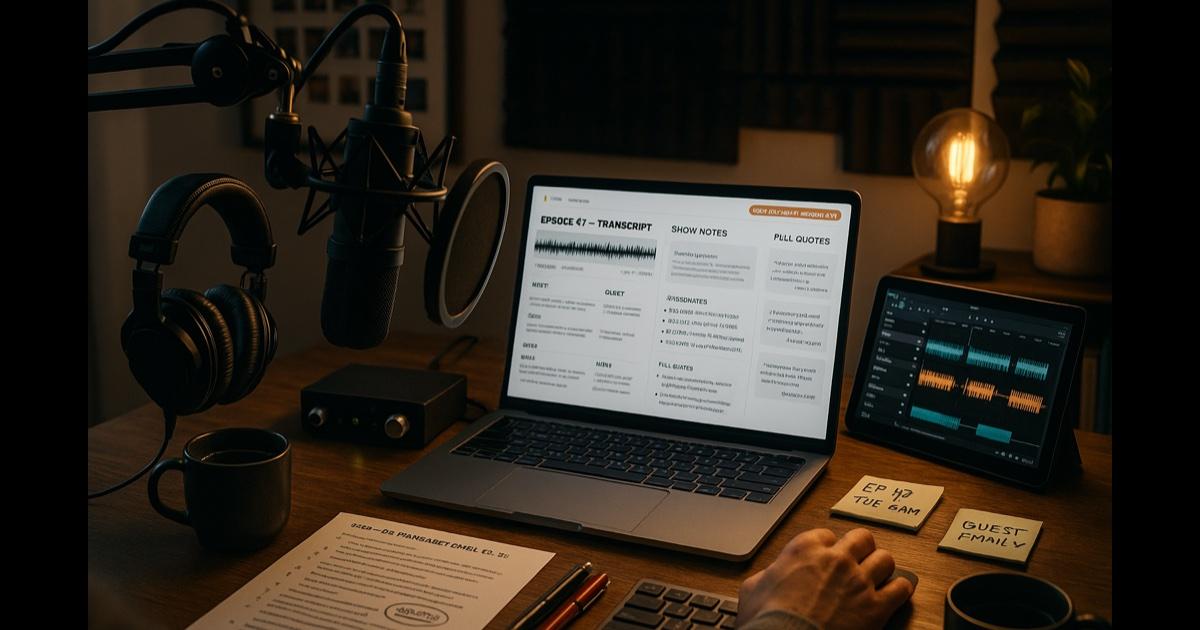
You just finished the recording. Ninety-three minutes. The audio is dry and clean. The guest was great. You closed the call, made coffee, sat down to write the show notes, and immediately found seven other things you needed to do.
It is now Friday. The episode publishes Tuesday morning at 6 a.m. Eastern. You have:
- One ninety-three minute audio file, untouched.
- A prep doc with the questions you actually asked, more or less.
- A guest bio they sent over the week before.
- Three or four moments you remember being great — but you don't remember exactly when in the recording they happened.
- A list in your phone titled "EDIT LATER" with twelve items from the last four episodes you have not, in fact, edited later.
The math of an indie podcast is brutal. The interview is the easy part. The publishing — show notes, transcript, chapter markers, pull-quotes for the newsletter, three social clips, an audiogram, the episode-page SEO, the guest-thank-you email with the assets they want — that's another four to six hours of grunt work, and it's the work that nobody hears. It's also why so many great shows ship two episodes and quit.
This is a sorting and packaging problem disguised as a creative one. The conversation is in the audio. The packaging is the bottleneck.
The move: turn one recording into the whole publishing package
Stop publishing audio. Start publishing a body of work — episode page, transcript, show notes, chapter markers, pull-quotes, social clips, newsletter, guest assets — all generated from the recording, all cited back to the exact timestamp.
You don't have to write any of it from scratch. You have to edit. Editing is faster than generating. Editing is also more fun.
The playbook
Friday afternoon: get the transcript (10 min)
Open CorpGPT. Create a Knowledge Base for the show: "[Podcast Name] — Episode Archive." For this episode, drop in:
- The audio file — let Live Recording transcribe it. Speaker-separated transcript with timestamps comes back in minutes, not hours.
- The prep doc with your intended questions.
- The guest bio.
- The guest's relevant prior work if any (their book, article, prior podcast appearances) — gives the tool context for the references the guest made off-script.
If you already used a transcription service, just upload that transcript instead. And if you also publish the episode on YouTube, you can summarize the recording straight from the video link instead of re-uploading the file. Either way, ten minutes from "I have an audio file" to "I have a searchable, cited episode."
Friday evening: generate the entire publishing package (45 min)
Open Knowledge Studio against the episode. Generate, in order:
- Episode summary — 100, 250, and 500 word versions. (You'll use all three: Apple Podcasts, episode page, newsletter.)
- Show notes — bulleted, with timestamps, formatted for Spotify and Apple. Include guest bio, key topics, links mentioned in the conversation, and a "more from the guest" section.
- Chapter markers — natural conversation breaks with timestamps and short titles. Paste straight into the chapter file or YouTube description.
- Pull-quotes sheet — the 8-12 best lines from the guest, each with a timestamp citation.
- Three social clip recommendations — moments worth pulling for audiograms, with start/end timestamps and a one-line caption suggestion.
- Newsletter draft — your voice, episode framing, two or three pull-quotes, a couple of links, the CTA. Edit it into your voice; don't ship it raw.
- Episode page meta — SEO title, meta description, three keyword groups, FAQ section if relevant.
- Guest thank-you email with the assets package (transcript link, pull-quotes, suggested social copy for the guest to use).
Forty-five minutes for what used to be four hours of cold-staring at a Word document.
Saturday morning: pressure-test before publish (20 min)
Open Nova. Interrogate the episode the way a good editor would:
- "What was the strongest single argument the guest made? Quote it with the timestamp."
- "Where did the guest contradict themselves, even slightly?"
- "What references — books, papers, people, projects — did the guest mention? List with timestamps."
- "What's the moment that would surprise a listener? The one I'd want in the trailer."
- "If a hostile listener wanted to misquote this, where's the most-likely misquote risk? Cite the moment so I can add context in the show notes."
This is the work of a thoughtful producer that you usually don't have. Now you do, for fifteen minutes, on every episode.
Saturday afternoon: clip the audiograms (1 hour)
You have your three clip timestamps from Knowledge Studio. Open your audio editor. Cut the clips. Drop them into your audiogram tool. The captions are pre-written. The clips are pre-chosen. The episode is unrecorded one hour ago and now it has three social posts ready to schedule.
Sunday: edit, schedule, breathe
You edit the show notes into your voice. You spot-check the pull-quotes against the timestamps (one click). You write the personal note at the top of the newsletter — the one part that has to be you. You schedule everything: the episode upload to your host, the social posts to the buffer, the newsletter to send Tuesday at 8 a.m. You go outside.
Tuesday 6 a.m.: episode publishes itself
You don't even open the laptop. The host pushes to the directories. The newsletter sends at 8. The first audiogram drops at 10. The second at 2. The third Wednesday morning. The guest gets the thank-you email Tuesday afternoon with their assets package — and they share to their list because you made it ridiculously easy.
You shipped a complete episode package without making your weekend disappear. The "EDIT LATER" list, for once, has nothing on it.
Beyond the one episode
Build a searchable archive of every episode you've ever made
Keep dropping every transcript, every show notes file, every newsletter into the same Knowledge Base. You're now sitting on an archive that compounds. When a guest says "didn't you have someone on a year ago who talked about this?" — Intelligent Search finds the moment in seconds. When a journalist emails asking "has anyone discussed X on the show?" — Nova answers with citations to episode and timestamp.
Three years of your podcast becomes a queryable corpus. Your show is no longer a stack of files. It's a body of work.
Cross-episode pull-quotes for the year-end episode
End of year, ask Nova: "Find the ten best quotes from the entire archive on the topic of [theme]. Group by guest. Include timestamps." Your year-end roundup writes itself, in your voice, with the receipts attached. Want a between-seasons bonus drop? Spin those highlights into a quick audio overview with the AI podcast generator and give listeners something to chew on while you're off the air.
Use My Tutor to prep for the next interview
Guest sends you their book the night before. You haven't read it. My Tutor turns it into a 20-minute structured ramp — key arguments, where this guest is provocative, what other thinkers they're in conversation with, the questions a smart host would ask. You walk into the recording sounding like you've spent a week with the material.
Use Knowledge Studio for the pitch deck
Your show is two years old. You want to pitch a network. Knowledge Studio reads your archive and produces a sponsor deck with download trends, recurring themes, top guests, listener-quote pulls, and a "what makes this show different" statement — drawn from your own corpus, not invented.
The features doing the work
Live Recording — speaker-separated, timestamped transcripts of interviews and recordings. With consent.
Knowledge Studio — show notes, summaries, chapter markers, pull-quotes, social clips, newsletter drafts, episode-page SEO, guest thank-you packages. All from one upload, all cited.
Digital Assistant (Nova) — the editor you don't have. Cited cross-episode questions. Quote verification by timestamp.
Intelligent Search — find the moment, the guest, the reference, the running joke from three years of episodes.
My Tutor — 20-minute structured ramp on a guest's body of work the night before the interview.
Why this actually works
Three quiet forces are doing the work.
First, the bottleneck on every indie podcast is post-production packaging, not the show itself. Most great podcasts die at episode 17 not because the host got bored of recording but because the host got bored of writing show notes at 11 p.m. Cut that work to a fraction and the show survives long enough to find its audience.
Second, every episode of an interview podcast is a small body of expertise — one or two hours of someone who knows something deeply. Treating that recording as a one-shot file is a waste. Treating it as a primary source you can query, repurpose, and revisit is how a podcast turns into a flywheel.
Third, citations to timestamps are the cleanest accountability mechanism a podcast has. If you say a guest said something, and the show note links to the moment, you're operating with the same clean-conscience hygiene a good journalist does. That stays with you.
What this can't do
Be honest.
CorpGPT does not record the episode for you. It does not know which guest is the right guest. It does not write your cold open or your sign-off in the voice of you. It does not have the chemistry. It does not laugh at the joke at the right moment. It does not have the editorial taste to know the show idea that's actually working from the one your friends are too kind to tell you isn't.
It is, again, a very good production assistant. The show is still your show.
And: always disclose AI-assisted production to your guests, and keep recordings/transcripts within the consent your guests agreed to. That's not a legal opinion — it's basic professional respect, and it's what keeps guests willing to come back.
The bottom line
Ninety-minute interview, done. Show notes, transcript, pull-quotes, chapter markers, three social clips, a newsletter, and the guest assets package — all from the same upload, all cited to the timestamp.
You publish on time. The "EDIT LATER" list, for once, says zero.
Open CorpGPT. Drop the audio. Ship the episode.
Keep reading
- Seventeen Transcripts. One Deadline. — how writers turn interview transcripts into themes, pulled quotes, and a working outline.
- Brand Says Bold. Legal Says Careful. — how marketing managers ship campaigns on time with brand and legal both signed off.
- How Are You Different From [Competitor]? — how sales reps get instant cited battlecard answers mid-call.
- 200 Resumes. One Hour. — how recruiters surface signal from a big applicant pile.
- Answer Once. Help Forever. — how HR managers turn the handbook into a self-serve assistant.
- Another Meeting to Recap the Last Meeting — how PMs ship meeting recaps in two minutes.
- Client Deck Tomorrow. It's 8 PM. — how consultants synthesize four reports into a draft deck before midnight.
- It's 9 PM and You're Not a Lawyer — how small business owners review vendor contracts.
- Ten Minutes Between Sessions — how therapists keep their clinical library one prompt away.
- Beat the Binder: The Nurse's 12-Hour Shift Playbook — how nurses turn formularies into instant answers.
- Claim Denied. Find the Clause. — how insurance agents pinpoint the exclusion.
- Two Minutes Before the Client Call — how financial advisors sound sharp on every call.
- Tax Code Changed. Again. — how accountants translate new tax rules.
- 200-Page Contract at 4:45 on a Friday — how lawyers catch every trap in a weekend ambush.
- Doctors: Stop Charting After Hours — how physicians finish documentation before lunch.
- Answer 'Will I Qualify?' in Seconds — how mortgage brokers answer clients on the first call.
- Turn One Chapter Into a Week of Lessons — how teachers build a full week of materials from one chapter.
- Your Client Wants 30 Listings by Saturday — how real estate agents review 30 disclosure PDFs.
- Cram 400 Pages Before Morning — the student version of the same playbook.
- Sixty Videos In. Did I Already Post This? — how content creators turn their back catalog into a searchable content brain.
- Sixty Papers. One Lit Review. One Weekend. — how researchers turn a stack of PDFs into summaries, themes, citations, and gaps.
- Three Investor Meetings. Three Different Decks. — how founders tailor a pitch per investor.
- 47-Page Brief. Proposal Due Friday. — how freelancers turn dense briefs into proposals in hours.
- Your Kid Just Asked About Algebra. — how parents help with homework using the actual textbook.
- Medicare Sent a Letter. 12 Pages. Tiny Font. — how older adults turn any letter into a plain-English one-pager.
- See all use cases — podcasters, writers, marketers, sales reps, recruiters, HR, PMs, consultants, small business owners, therapists, nurses, doctors, insurance agents, advisors, accountants, lawyers, brokers, agents, teachers, students, and more.
- Plans & pricing — free tier included, no credit card required.