Business·April 9, 2026
Brand Says Bold. Legal Says Careful. The Marketing Manager's Playbook.
TL;DR
Brand wants bold. Legal wants careful. Launch Friday. Here's the marketing manager's playbook to ship campaigns with brand and legal both signed off — on time.
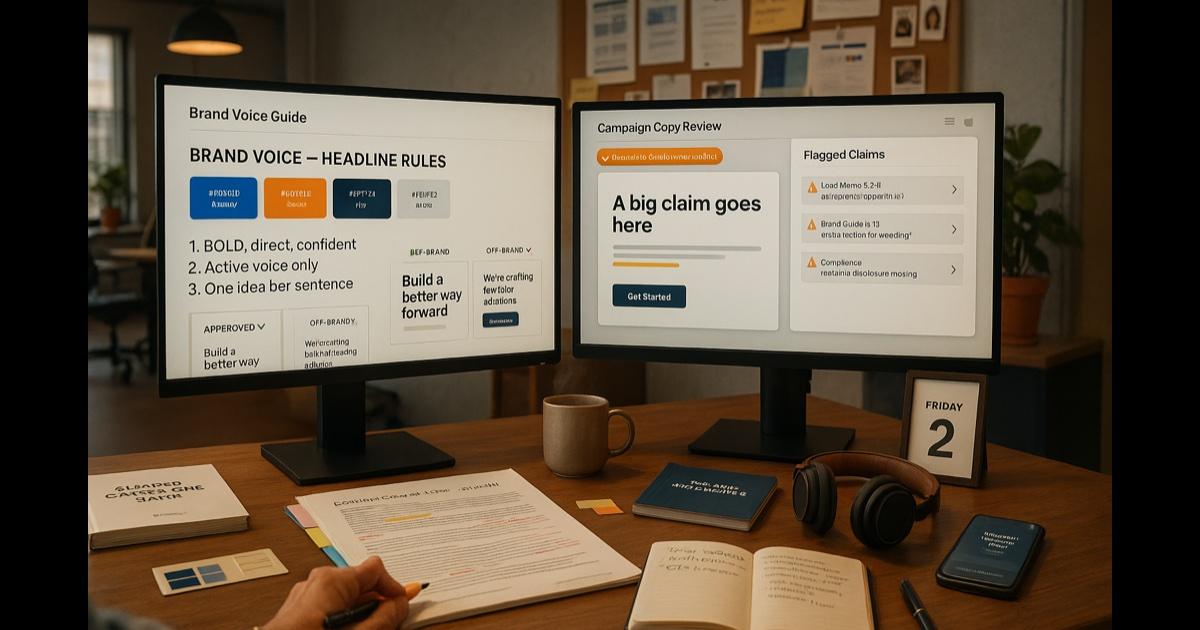
It's Tuesday morning. Campaign launches Friday. The brief was "approved" two weeks ago, which, in practice, means: brand has notes, legal has notes, product has notes, and the performance team has strong opinions about the CTA that nobody asked for.
You have:
- A 42-page brand guide that specifies "bold, direct, confident" voice — with seven examples of what that means.
- A legal & compliance memo from last quarter that says "avoid any language implying guaranteed results or specific outcomes" — with eight examples of what that means.
- A competitive intel deck your team built in January with positioning against the two main rivals.
- A customer research readout with the pain points the campaign is supposed to address.
- The product spec the campaign is selling, plus an updated messaging doc you're 60% sure is the final version.
- A creative review in 48 hours and a legal review in 72 hours and a campaign launch in 96 hours.
You have not yet written the landing page headline.
Every marketer has this Tuesday. The information exists. It lives in seven places. And the stuff in document A directly contradicts the stuff in document B, because brand was written by the brand team and legal was written by the legal team and nobody has had the conversation about which rule wins when they collide.
Here is what actually works.
The move: make the library argue with itself before you do
The mistake most marketing teams make is writing the copy first, submitting it for review, then playing whack-a-mole as brand and legal each fire back notes from their own doc. You write version 1, brand flags it, you fix, legal flags the fix, you fix, brand flags that fix. Two weeks later you ship a watered-down version of a paragraph you could have written in an hour if you'd known what the rules actually were.
Stop writing blind. Upload your brand guide, your legal guidelines, your approved messaging, and your prior campaign artifacts into one Knowledge Base. Let the tool surface the rules and the conflicts. Then write — once — with both teams' rules already accounted for.
The playbook
One evening: build the marketing brain (30 min)
Open CorpGPT. Create a Knowledge Base: "Brand & Campaign Library." Drop in:
- The brand guide (voice, tone, visual, taglines, what to never say).
- The messaging framework (value prop, positioning, proof points, claims).
- The legal & compliance memo and approved claims language.
- Prior approved campaign assets — landing pages, emails, ad copy — as examples of "this cleared review."
- Prior campaign postmortems — what worked, what didn't, what reviewers hated.
- Customer research — recent win/loss, NPS verbatims, interview transcripts, customer quotes.
- Competitive intel — how we talk about them, what we avoid claiming.
- The ICP and persona docs.
- Your content calendar and any launch narratives from the past year.
Thirty minutes, and your whole brand brain is in one place.
Tuesday morning: make the library fight (15 min)
Before you write a word of copy. Open the Digital Assistant (Nova) and ask the questions that will save you a week of review cycles:
- "What does the brand guide say about headline voice and structure?"
- "What does legal say we can and cannot claim about [product]?"
- "Where does the brand voice guidance conflict with the legal claims language? Give me specific examples."
- "What phrases or words are on the brand 'never use' list?"
- "What's the approved range of ways we refer to [competitor]?"
- "Pull three examples of landing page headlines from past campaigns that cleared legal review."
You get a written, cited map of the constraints — including the conflicts. Send the conflict list to your brand and legal partners with "Hey, before I draft — can you two align on how to handle these five tensions? Here's the evidence from your own guidelines." That conversation has to happen eventually. Make it happen Tuesday, not Thursday night.
Tuesday afternoon: draft the campaign (1-2 hours)
Now you write — but not from blank. Open Knowledge Studio against the library. Ask for:
- Landing page copy — hero section, subhead, three value-prop bullets, social proof section, CTA. Grounded in the messaging doc and checked against brand voice and claims language.
- Email nurture sequence — three emails, each with subject line options, preview text, body, CTA.
- Paid social — three hooks, three body variations, three CTAs per hook.
- One-sentence hero pitch — for the deck, the press release, and internal stakeholders.
- A "this campaign at a glance" one-pager — for exec review.
Each output is cited. The drafts are a solid 70% — not your final copy, but a starting point that's already on-brand and already accounting for legal guardrails.
Wednesday: pressure-test before review (30 min)
Before you submit the drafts to brand and legal, ask Nova to do pre-review. If your campaign hinges on a partner agreement or vendor terms, you can also run the underlying contract through an AI review to check the exact clause you're allowed to reference before it ever reaches legal:
- "Scan the landing page draft against the brand voice rules. Where does it deviate? Cite the rule."
- "Scan all the draft copy against the legal claims language. Flag anything that could be read as an outcome guarantee, efficacy claim, or prohibited phrase. Cite the rule."
- "Are there any words on the brand 'never use' list anywhere in this draft?"
- "Pretend you are the skeptical compliance reviewer from last campaign. What would you flag?"
Fix the obvious stuff before it goes to review. Reviewers respect drafts that already passed the easy checks. You stop being the marketer who submits copy that says "guaranteed" in the headline.
Thursday: review happens in one round, not four
Because the draft already accounted for the rules, the review cycle is about the edge cases — the handful of judgment calls that genuinely need human review. Not the obvious misses. Legal approves in hours, not days. Brand has three small tweaks, not twenty.
Friday ships on time.
Beyond the one campaign
Build a campaign-specific Knowledge Base
Every major launch gets its own folder inside the brand library: "[Campaign Name] — Q2." Drop in the brief, the asset list, the deliverables, the reviewer feedback, and the postmortem when you ship. Six months later when someone asks "what did we say about pricing in that launch?", Intelligent Search finds it in seconds.
Use My Tutor to ramp new hires
New marketer joining? Drop them in with the brand library and a 30-minute My Tutor session on "our brand voice — the short version." They ramp in days instead of quarters. The brand guide finally gets read (in 90-second bursts, which is how it was always going to get read).
Record launch retros and stakeholder reviews
Live Recording captures the retro and the review meetings (with consent). Transcripts go in the Knowledge Base. Next campaign, you ask Nova: "What feedback did the CMO have on the last landing page?" Answered in seconds, with the timestamp from the call.
Keep the calendar intact
Use Knowledge Studio to generate weekly status updates, stakeholder one-pagers, and executive briefings from the campaign folder on demand. Your Monday-morning status email stops eating Sunday night.
The features doing the work
Knowledge Studio — campaign brief, landing page copy, email sequences, paid social, press release, one-pagers, executive briefings. Each output under 60 seconds, grounded in your brand and compliance library.
Digital Assistant (Nova) — cited answers to "what does brand say about X?" and "what does legal say about X?" — and, critically, to "where do brand and legal conflict?"
Intelligent Search — find the approved phrasing from a past campaign, the reviewer's note from last quarter, the customer quote that fits this hero section. All by intent.
My Tutor — structured 20-minute ramp for new hires on the brand library.
Live Recording — capture retros, stakeholder reviews, and customer-research debriefs. Transcripts become permanent, searchable campaign memory.
Why this actually works
Three forces are doing the real work.
First, brand consistency is a search problem, not a memory problem. You have the guide. You don't need to have it memorized — you need to be able to query it while you're writing, in three seconds, with citations. That's the interface your brand guide has been waiting for.
Second, the conflicts between brand and legal are structural, not accidental. Brand wants punchy. Legal wants careful. Those two teams will always have some tension. Surfacing the conflicts up front — before the copy gets written — turns the tension into a decision your org makes once, in writing, instead of a fight your team has on every campaign.
Third, first drafts finally arrive at review already 70% clean. Reviewers aren't your unpaid copy editors. Their time is for the judgment calls. When you submit drafts that have already been scanned against the rules, review is fast, feedback is substantive, and campaigns ship.
What this can't do
Be honest about this.
CorpGPT does not clear copy for regulated industries. It does not replace your legal and compliance review. It does not decide brand strategy, creative direction, or positioning. It does not know that the VP of Product hates the word "seamless," or that the CEO has a specific feeling about Oxford commas.
It also does not write copy with your team's specific craft. The first draft is a first draft. The punchline, the rhythm, the human observation that makes a headline land — that's still a copywriter's job. The tool handles the grunt work around the craft so your copywriters can actually do the craft.
The bottom line
Brand says bold. Legal says careful. Campaign ships Friday. Brief ships never.
Upload both. Find the conflicts on Tuesday. Draft Tuesday afternoon with both sets of rules already accounted for. Pre-review Wednesday. Ship Friday. Keep everyone happy. Mostly.
Open CorpGPT. Upload the brand brain. Write the headline.
Keep reading
- How Are You Different From [Competitor]? — how sales reps get instant cited battlecard answers mid-call.
- 200 Resumes. One Hour. — how recruiters surface signal from a big applicant pile.
- Answer Once. Help Forever. — how HR managers turn the handbook into a self-serve assistant.
- Another Meeting to Recap the Last Meeting — how PMs ship meeting recaps in two minutes.
- Client Deck Tomorrow. It's 8 PM. — how consultants synthesize four reports into a draft deck before midnight.
- It's 9 PM and You're Not a Lawyer — how small business owners review vendor contracts.
- 200-Page Contract at 4:45 on a Friday — how lawyers catch every trap in a weekend ambush.
- Tax Code Changed. Again. — how accountants translate new tax rules.
- Two Minutes Before the Client Call — how financial advisors sound sharp on every call.
- Claim Denied. Find the Clause. — how insurance agents pinpoint the exclusion.
- Ten Minutes Between Sessions — how therapists keep their clinical library one prompt away.
- Beat the Binder: The Nurse's 12-Hour Shift Playbook — how nurses turn formularies into instant answers.
- Doctors: Stop Charting After Hours — how physicians finish documentation before lunch.
- Answer 'Will I Qualify?' in Seconds — how mortgage brokers answer clients on the first call.
- Turn One Chapter Into a Week of Lessons — how teachers build a full week of materials from one chapter.
- Your Client Wants 30 Listings by Saturday — how real estate agents review 30 disclosure PDFs.
- Cram 400 Pages Before Morning — the student version of the same playbook.
- Seventeen Transcripts. One Deadline. — how writers turn a pile of interview transcripts into themes, pulled quotes, and a working outline.
- Ninety-Minute Interview. Show Notes by Tuesday. — how indie podcasters ship the entire post-production package from one upload.
- Sixty Videos In. Did I Already Post This? — how content creators turn their back catalog into a searchable content brain.
- Sixty Papers. One Lit Review. One Weekend. — how researchers turn a stack of PDFs into summaries, themes, citations, and gaps.
- Three Investor Meetings. Three Different Decks. — how founders tailor a pitch per investor.
- 47-Page Brief. Proposal Due Friday. — how freelancers turn dense briefs into proposals in hours.
- Your Kid Just Asked About Algebra. — how parents help with homework using the actual textbook.
- Medicare Sent a Letter. 12 Pages. Tiny Font. — how older adults turn any letter into a plain-English one-pager.
- See all use cases — marketing managers, sales reps, recruiters, HR managers, PMs, consultants, small business owners, therapists, nurses, doctors, insurance agents, advisors, accountants, lawyers, brokers, agents, teachers, students, and more.
- Plans & pricing — free tier included, no credit card required.