Work & Productivity·April 6, 2026
Tax Code Changed. Again. The Accountant's Playbook.
TL;DR
Tax code changed again. Forty clients, one question. Here's the accountant's playbook to read the IRS pub once and answer every client with a citation.
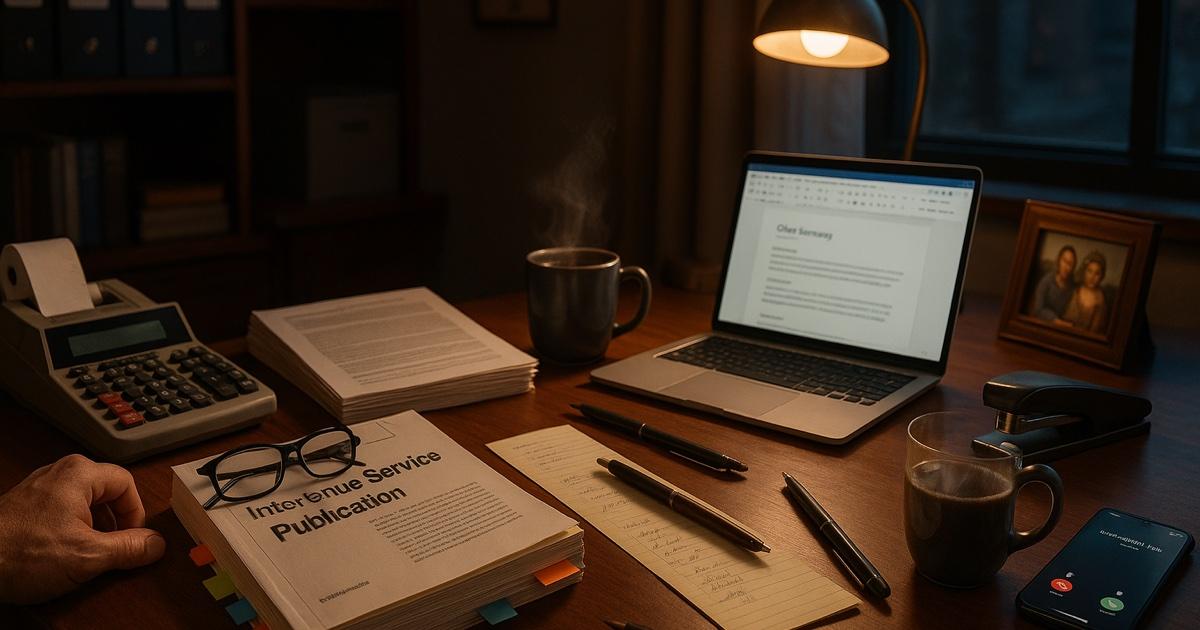
It is 6:47 PM. Your phone is ringing. It's the third "quick question" of the day.
"Hey — so I saw something about the new bonus depreciation rules on LinkedIn. Does that apply to my rental? Also, what's this I'm hearing about the R&D credit? And — sorry, one more — the SALT cap, did that actually change or is that just what my brother-in-law thinks?"
You know where most of these answers live. Somewhere in the 312-page IRS publication you downloaded last week. Or in the Rev. Proc. that came out Tuesday. Or in the state conformity memo your research group sent around. The answers exist. Finding them in the fifteen minutes before your next call, not so much.
Every tax season. Every time the tax code changes — which is every year now — your week becomes this. Read the regs. Translate the regs. Explain the regs. Bill for the regs. Try to eat something between calls.
Here is what actually works.
The move: stop reading the pub twice
The mistake every CPA makes during tax season is re-reading the same IRS pub for every client who calls. Client A asks about §179 expensing. You find it. Client B calls forty minutes later and asks about §179 for a different asset class. You go find it again. Client C calls Monday and asks the same question Client A asked on Thursday. You go find it a third time.
You already read the document. You shouldn't have to keep finding the answer.
Upload it once, then chat with the tax code like it's a document — ask it anything, cited answer back, every time, in seconds.
The playbook
Once: build your research library (20 min, one time)
Open CorpGPT. Upload the sources you actually use:
- The relevant IRS publications (Pub 17, Pub 535, Pub 527, Pub 946 — whichever ones you reach for).
- The new Rev. Procs. and Notices from this year.
- Your state's DOR publications and conformity guidance.
- Your firm's internal tax memos from partners who've already worked through the hard cases.
- Any CCH, Checkpoint, or BNA PDFs you have rights to.
This is a one-time lift. Twenty minutes. From now on, every research question you have lives in one searchable place.
On every client call: ask Nova in plain English
Client says: "Can I expense the new HVAC in my rental?"
You type into the Digital Assistant (Nova): "§179 expensing for HVAC in residential rental property — is it allowed, what's the cap, and what's the effective date?"
Nova answers in ten seconds, inline, with citations: "Pub 946, Ch. 2 — HVAC placed in service after 12/31/2017 qualifies for §179 expensing on nonresidential real property. Residential rental property does not qualify for §179 but may qualify for bonus depreciation under §168(k)..."
You click the citation, eyeball the exact paragraph, and read it back to the client in English.
No flipping. No "let me get back to you." No skimming a pub you already skimmed last week.
For the new rule: interrogate it
The Rev. Proc. landed Tuesday. It's fifty-four pages of cross-references and legislative history. Your inbox has eleven clients asking what it means for them.
Upload the Rev. Proc. once. Ask Nova:
- "What's the effective date, and does it apply retroactively?"
- "Who does this apply to, and who's excluded?"
- "Give me three examples of situations this changes."
- "How does this interact with the existing §199A rules?"
- "Is there a de minimis threshold?"
- "What's the transition relief, if any?"
Twenty minutes, ten cited answers, and you can now advise clients confidently on a rule that came out less than a week ago. Before, that research was a Saturday.
For the client: turn the answer into a handout
Open Knowledge Studio. Feed it the Rev. Proc. and ask for:
- Client Summary — a one-page plain-English explainer with no jargon. Email it to affected clients before they call.
- FAQ — eight to ten likely client questions with answers. Post it on your firm's Client Portal.
- Infographic — a visual version of the decision tree: does this apply to you? If yes, what changes?
- Executive Briefing — the two-minute partner-ready version for your Monday meeting.
Thirty minutes, four client-ready deliverables, all grounded in the actual Rev. Proc. with citations. That used to be a senior associate's full afternoon.
For the firm: make the research findable
Drop everything — the pub, the Rev. Proc., your memos, the summaries — into a Knowledge Base folder labeled "2026 Tax Updates." Next month when the next associate asks, you don't re-answer. You point. They use Intelligent Search to find it by intent, not exact keyword.
Next year, same thing. The research compounds instead of vanishing into somebody's Downloads folder.
The features doing the work
Digital Assistant (Nova) — plain-English Q&A against your uploaded regs and pubs with page citations. Every answer verifiable in one click.
Knowledge Studio — 33 outputs from one source, each under 60 seconds. Client summaries, FAQs, infographics, executive briefings, explainer videos of a rule, mind maps of a Rev. Proc.
Intelligent Search — find anything you uploaded by intent. "That memo about the §199A carve-out — had a table comparing pre- and post-2025" → found in three seconds.
My Tutor — for the associate who needs to learn the new rule end-to-end before Monday. Twenty-minute session on the Rev. Proc., private, no billable hours lost.
Live Recording — record the client call (with consent). Transcribed automatically. You get the action items and the client gets a shareable summary. No more "what did I tell them last month?"
Why this actually works
Three forces are doing the real work.
First, plain English beats keyword search. Tax pubs are not indexed the way your clients think. Your client asks "can I deduct the HVAC?" and the pub calls it "placed-in-service real property improvements under §179(f)." Nova bridges that gap in seconds.
Second, citations make it defensible. Every answer points to a specific page of a specific pub. You verify before you advise. No hallucination, no "the AI said so." The IRS would also like you to cite your source, as it happens.
Third, research stops vanishing. The single biggest productivity leak in a tax firm is the same research being redone by three associates and a partner who all ran into the same question in a different week. Once it's in your Knowledge Base, it's done once, forever.
What this can't do
Be honest about this.
CorpGPT is not a tax advisor. It does not file returns. It does not make §1031 elections or §338(h)(10) calls. It does not know your client's full fact pattern, their risk tolerance, or the state DOR agent they angered in 2019.
What it does is eliminate the research bottleneck. The part where a real CPA question becomes three hours of flipping through pubs. The lookup, the summarization, the first-draft client explainer — that's grunt work. The judgment call, the election, the signed return — that's still you.
You are the CPA. The tool is the best-prepared associate you ever had, minus the billable hours.
The bottom line
Tax code changed. Again. Your client wants the summary. Yesterday.
Answer every "quick question" with a citation. Email clients the plain-English explainer before they call. Walk into the partner meeting with a two-minute briefing on the new Rev. Proc.
Advise fast. Bill confident. Explain deductions without the glazed-over eyes.
Open CorpGPT. Upload the pub. Take the next call.
Keep reading
- 200-Page Contract at 4:45 on a Friday — how lawyers catch every trap in a weekend contract ambush and still make it to dinner.
- Answer 'Will I Qualify?' in Seconds — how mortgage brokers answer clients on the first call.
- Doctors: Stop Charting After Hours — how physicians finish documentation before lunch instead of after dinner.
- Turn One Chapter Into a Week of Lessons — how teachers build a full week of materials from a single source chapter in one evening.
- Your Client Wants 30 Listings by Saturday — how real estate agents review 30 disclosure PDFs in one afternoon.
- Cram 400 Pages Before Morning — the student side of the same playbook, the night before an exam.
- Two Minutes Before the Client Call — how financial advisors sound sharp on every unscheduled portfolio call with cited research.
- Claim Denied. Find the Clause. — how insurance agents pinpoint the exact exclusion in an 80-page policy and win the callback.
- Beat the Binder: The Nurse's 12-Hour Shift Playbook — how nurses turn hospital formularies and protocol binders into instant cited answers at the bedside.
- Ten Minutes Between Sessions — how therapists keep their clinical library, CE, and psychoeducation handouts one prompt away.
- It's 9 PM and You're Not a Lawyer — how small business owners review vendor contracts, catch red flags, and sign smart without a legal team.
- Client Deck Tomorrow. It's 8 PM. — how consultants synthesize four reports into a draft deck and pressure-test the story before midnight.
- Another Meeting to Recap the Last Meeting — how project managers record meetings and ship the summary, decisions, and action items in two minutes.
- Answer Once. Help Forever. — how HR managers turn the handbook into a self-serve, cited-answer assistant and finally take a lunch break.
- 200 Resumes. One Hour. — how recruiters surface signal from a 200-resume pile and walk into the hiring manager intake actually prepared.
- How Are You Different From [Competitor]? — how sales reps get instant cited battlecard answers mid-call and do the follow-up in five minutes.
- Brand Says Bold. Legal Says Careful. — how marketing managers ship campaigns on time with brand and legal both signed off.
- Seventeen Transcripts. One Deadline. — how writers turn a pile of interview transcripts into themes, pulled quotes, and a working outline.
- Ninety-Minute Interview. Show Notes by Tuesday. — how indie podcasters ship the entire post-production package from one upload.
- Sixty Videos In. Did I Already Post This? — how content creators turn their back catalog into a searchable content brain.
- Sixty Papers. One Lit Review. One Weekend. — how researchers turn a stack of PDFs into summaries, themes, citations, and gaps.
- Three Investor Meetings. Three Different Decks. — how founders tailor a pitch per investor.
- 47-Page Brief. Proposal Due Friday. — how freelancers turn dense briefs into proposals in hours.
- Your Kid Just Asked About Algebra. — how parents help with homework using the actual textbook.
- Medicare Sent a Letter. 12 Pages. Tiny Font. — how older adults turn any letter into a plain-English one-pager.
- See all use cases — accountants, lawyers, brokers, agents, doctors, teachers, students, and more.
- Plans & pricing — free tier included, no credit card required.