Business·April 14, 2026
Client Deck Tomorrow. It's 8 PM. The Consultant's Playbook.
TL;DR
Client deck tomorrow. 8 PM. Four reports, no story yet. Here's the consultant's playbook to synthesize the deck and pressure-test the story before midnight.
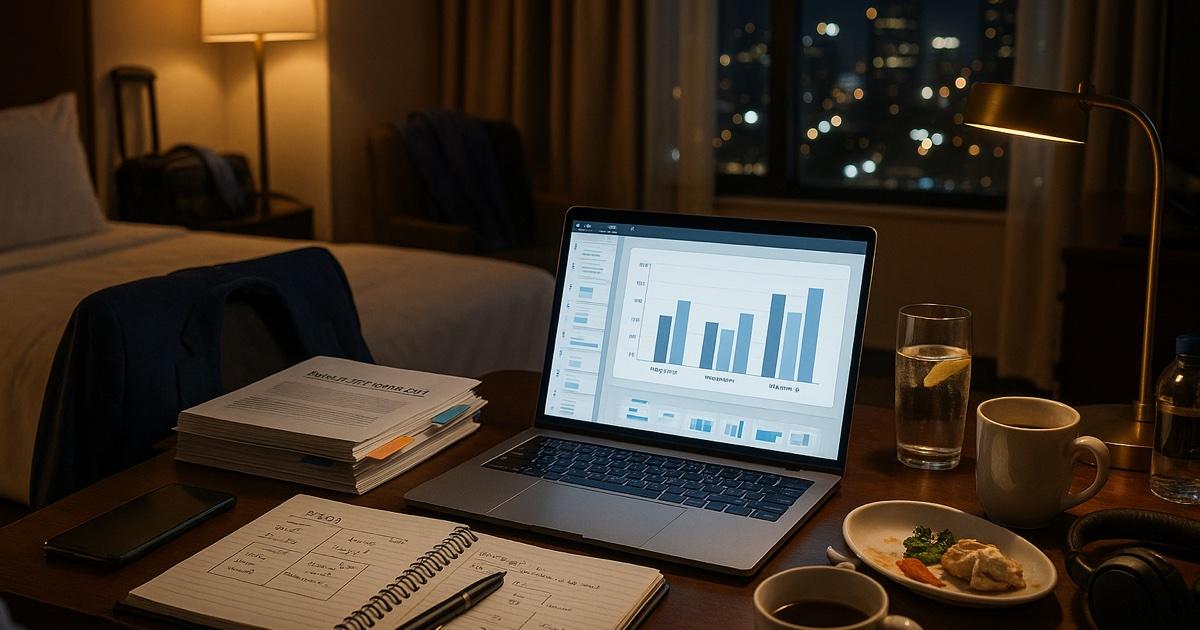
It's 8:14 PM. You are in a hotel room in a city you didn't fly into voluntarily. The drapes don't fully close. The ice machine is loud. Room service brought the wrong dressing.
The deck is due tomorrow at 9 AM. The partner reviews at 7 AM, which means it has to be in their inbox by 6:45. Which means tonight.
You have four sources to synthesize. The client's internal data dump (Excel, 14 tabs, six tabs unlabeled). A bought industry report from Gartner or McKinsey or whoever, 92 pages. The transcripts from three expert calls your team ran last week. And — generously — last year's deck on a similar problem from a different vertical, "for inspiration."
You have not yet started the slides. You also have not yet figured out the storyline. You have not figured out, in fact, whether the answer the data is pointing to is the same answer the partner has been hinting at on calls all week, which is a separate problem you'll deal with around 11 PM after the third coffee.
Every consultant has had this Tuesday. The deck-from-sources synthesis is the core grunt work of the job — and the part that, more than anything else, eats the late night.
Here is what actually works.
The move: stop staring at four documents at once
The mistake every consultant makes at 8 PM is opening four windows side by side, scrolling through each one, and trying to hold the synthesis in their head. The brain is not a synthesis engine. It's a pattern-recognition engine that gets dramatically worse around 10 PM.
Stop synthesizing in your head. Get the synthesis on paper. Then judge it, edit it, and turn it into the deck.
The playbook
8:14 PM. Upload the stack (3 min)
Open CorpGPT. Drop in:
- The client's data dump (Excel, CSVs, the operating model PDF, the org chart).
- The Gartner / McKinsey / IDC industry report.
- The expert call transcripts (three of them).
- Last year's "comparable" deck, sanitized.
- Anything else on the project shared drive that's been on your reading list.
Three minutes. Everything in one searchable place.
8:17 PM. Get the synthesis (10 min)
Open Knowledge Studio. Run, in this order:
- Mind map of all four sources combined. The visual shows you where they reinforce each other, where they branch, and where one source has a whole arm the others don't touch. Useful for spotting the synthesis before you commit to a storyline.
- Executive briefing — let the AI summarize the source docs into a one-page summary of the key facts, themes, and tensions across all four sources, including that 92-page industry report. This is your raw material for slide 2.
- Key insights list — the eight to ten most defensible claims that emerge across the sources, each cited to where they came from.
- Slide deck draft — a 12-to-15-slide outline with titles, bullets, and recommended supporting data. Let it build the deck straight from the report so you start from slides, not a cursor blinking on an empty canvas.
Ten minutes. You now have a coherent first draft of the story. It is not the final answer. It is, however, a much better starting point than a blank slide at 8:30 PM.
8:27 PM. Decide the storyline (15 min)
This is the part the tool can't do. The framework, the punchline, the "so what" — that's you.
Look at the executive briefing and the key insights. Decide:
- What's the headline? One sentence. The chart that goes on slide 1 is the chart that supports this sentence.
- What's the storyline? SCQA, pyramid, three-act — pick a structure. Sketch it on the hotel notepad. Five bullets max.
- What's the recommendation? What is the client supposed to do differently because of this deck?
Fifteen minutes. Now you know what the deck is.
8:42 PM. Pressure-test before you build (20 min)
This is where the tool earns its keep at 8:42 PM. Open the Digital Assistant (Nova) and ask the questions a brutal partner would ask:
- "What's the weakest argument in the executive briefing?"
- "Where do the four sources disagree, and which one wins?"
- "What's the obvious counterargument the client's CFO will raise?"
- "Which claims here are not actually supported by the source data we uploaded?"
- "Are we cherry-picking? Where?"
- "What would change my mind about the recommendation?"
Each answer is cited back to specific paragraphs in specific sources. You either find the supporting data, you soften the claim, or you cut the slide. Better to fail fast in the hotel room at 8:50 than in front of the client at 9:30 the next morning.
9:02 PM. Build the deck (90 min)
You now have:
- A storyline.
- A pressure-tested set of insights.
- A first draft of titles and bullets.
- A list of charts you need from the data dump.
The actual building — the polish, the chart formatting, the brand-compliant template, the executive voice — is still you. But you're filling in a structure, not staring at blanks. Ninety minutes turns into a deck a senior associate would be proud to put their name on.
If your firm uses a templated deck system, Knowledge Studio can generate the infographic version of any slide — useful for the appendix or the "summary slide" the partner always asks for at 6:50 AM.
10:32 PM. Do the partner pre-mortem (15 min)
Before you call it: ask Nova one more time.
- "Pretend you are [partner name]'s style of partner — incisive, skeptical, fast. Read this deck and give me the three questions you'd ask first."
Whatever it gives you, that's where you need a backup slide or a one-liner ready. Add a backup section. Now you've already lived through the partner review and survived.
10:50 PM. Send. Sleep.
Email lands in the partner's inbox at 10:51. You're in bed at 11:05. Tomorrow morning you wake up to feedback you can actually action, not feedback that requires rebuilding the storyline.
Beyond the one deck: the consultant's library
Once you've used CorpGPT for one project, the real win is in the second project.
Build a library of every prior deck (sanitized)
Drop your team's past sanitized decks into a Knowledge Base folder. Industry primers. Expert call transcripts. Frameworks documents. Market research you bought once and want to reuse. Intelligent Search finds anything by intent — "the deck where we used the maturity-curve framework on a SaaS pricing case" → found. Your second project gets dramatically faster because your firm's IP finally acts like IP.
Use My Tutor to ramp on a new industry fast
Staffed on a vertical you've never worked in? Upload three industry primers, two analyst reports, and a textbook. Run a 30-minute My Tutor session before your kickoff call. Walk in able to ask intelligent questions instead of taking notes silently.
Record expert calls (with consent)
Live Recording captures the call, transcribes it automatically, and drops the transcript into your project library. You stop re-listening to recordings. The expert's quote you need at 9:47 PM the night before the deck is searchable in seconds.
The features doing the work
Knowledge Studio — slide deck draft, executive briefing, mind map, infographic, key insights list — each in under 60 seconds, grounded in the documents you uploaded.
Digital Assistant (Nova) — synthesis Q&A and pressure-testing, all with cited answers. The substitute partner-in-the-room at 8:47 PM.
Intelligent Search — recall any prior project artifact across your library by intent.
My Tutor — fast vertical ramp before a kickoff. 20 minutes private, before the partner sees you stumble on the first call.
Live Recording — expert calls and team meetings, transcribed and searchable forever.
Why this actually works
Three forces are doing the real work.
First, synthesis is a search-and-organize problem before it's a creative problem. The "what does the data say" part is mechanical. The tool extracts it faster and more comprehensively than your tired brain at 9 PM. The "so what" — the framework, the punchline, the recommendation — is human, and it's easier to do once the synthesis is on paper.
Second, citations make every slide defensible. When the client's CFO asks "where does this number come from?" mid-meeting, you have a one-second answer that points to the page of the source. That changes how clients receive the work.
Third, your firm's IP finally compounds. Every project's research, primers, frameworks, and sanitized deliverables make the next project's first night faster. That's the entire point of being at a consulting firm. Most firms fail to do this. The Knowledge Base is how it actually starts to work.
What this can't do
Be honest about this.
CorpGPT does not do strategy. It does not have client context, partner judgment, or the gut sense from twenty engagements that tells you when the data is leading you somewhere unhelpful. It does not pick the framework. It does not write the punchline. It does not know that the client's CEO has a strong personal opinion about pricing and you should soften slide 7.
What it does is the synthesis, the first draft, the pressure-test, the citation discipline. The grunt work that used to eat the night. The thinking — the framework choice, the storyline, the recommendation — is still you. The deck is still your deck. The tool just gives you back the three hours you used to lose to flipping between PDFs.
The bottom line
Client deck. Tomorrow at 9. Four reports. It's already 8 PM.
You synthesize in fifteen minutes. You decide the storyline in fifteen more. You pressure-test in twenty. You build the deck in ninety. You're in bed by eleven.
Sound like a genius. Charge like one. Actually go to bed.
Open CorpGPT. Upload the four reports. Open the deck.
Keep reading
- It's 9 PM and You're Not a Lawyer — how small business owners review vendor contracts, catch red flags, and sign smart without a legal team.
- 200-Page Contract at 4:45 on a Friday — how lawyers catch every trap in a weekend ambush and still make it to dinner.
- Tax Code Changed. Again. — how accountants translate new tax rules into client-ready answers with citations in seconds.
- Two Minutes Before the Client Call — how financial advisors sound sharp on every unscheduled portfolio call with cited research.
- Claim Denied. Find the Clause. — how insurance agents pinpoint the exact exclusion in an 80-page policy.
- Ten Minutes Between Sessions — how therapists keep their clinical library, CE, and psychoeducation handouts one prompt away.
- Beat the Binder: The Nurse's 12-Hour Shift Playbook — how nurses turn hospital formularies into instant cited answers at the bedside.
- Doctors: Stop Charting After Hours — how physicians finish documentation before lunch instead of after dinner.
- Answer 'Will I Qualify?' in Seconds — how mortgage brokers answer clients on the first call.
- Turn One Chapter Into a Week of Lessons — how teachers build a full week of materials from a single source chapter in one evening.
- Your Client Wants 30 Listings by Saturday — how real estate agents review 30 disclosure PDFs in one afternoon.
- Cram 400 Pages Before Morning — the student version of the same playbook.
- Another Meeting to Recap the Last Meeting — how project managers record meetings and ship the summary, decisions, and action items in two minutes.
- Answer Once. Help Forever. — how HR managers turn the handbook into a self-serve, cited-answer assistant and finally take a lunch break.
- 200 Resumes. One Hour. — how recruiters surface signal from a 200-resume pile and walk into the hiring manager intake actually prepared.
- How Are You Different From [Competitor]? — how sales reps get instant cited battlecard answers mid-call and do the follow-up in five minutes.
- Brand Says Bold. Legal Says Careful. — how marketing managers ship campaigns on time with brand and legal both signed off.
- Seventeen Transcripts. One Deadline. — how writers turn a pile of interview transcripts into themes, pulled quotes, and a working outline.
- Ninety-Minute Interview. Show Notes by Tuesday. — how indie podcasters ship the entire post-production package from one upload.
- Sixty Videos In. Did I Already Post This? — how content creators turn their back catalog into a searchable content brain.
- Sixty Papers. One Lit Review. One Weekend. — how researchers turn a stack of PDFs into summaries, themes, citations, and gaps.
- Three Investor Meetings. Three Different Decks. — how founders tailor a pitch per investor.
- 47-Page Brief. Proposal Due Friday. — how freelancers turn dense briefs into proposals in hours.
- Your Kid Just Asked About Algebra. — how parents help with homework using the actual textbook.
- Medicare Sent a Letter. 12 Pages. Tiny Font. — how older adults turn any letter into a plain-English one-pager.
- See all use cases — consultants, small business owners, therapists, nurses, doctors, insurance agents, advisors, accountants, lawyers, brokers, agents, teachers, students, and more.
- Plans & pricing — free tier included, no credit card required.