Business·April 21, 2026
How Are You Different From [Competitor]? The Sales Rep's Playbook.
TL;DR
Mid-pitch objection, prospect leaning in, blank brain. Here's the sales rep's playbook to turn battlecards into instant cited answers — and sound sharp.
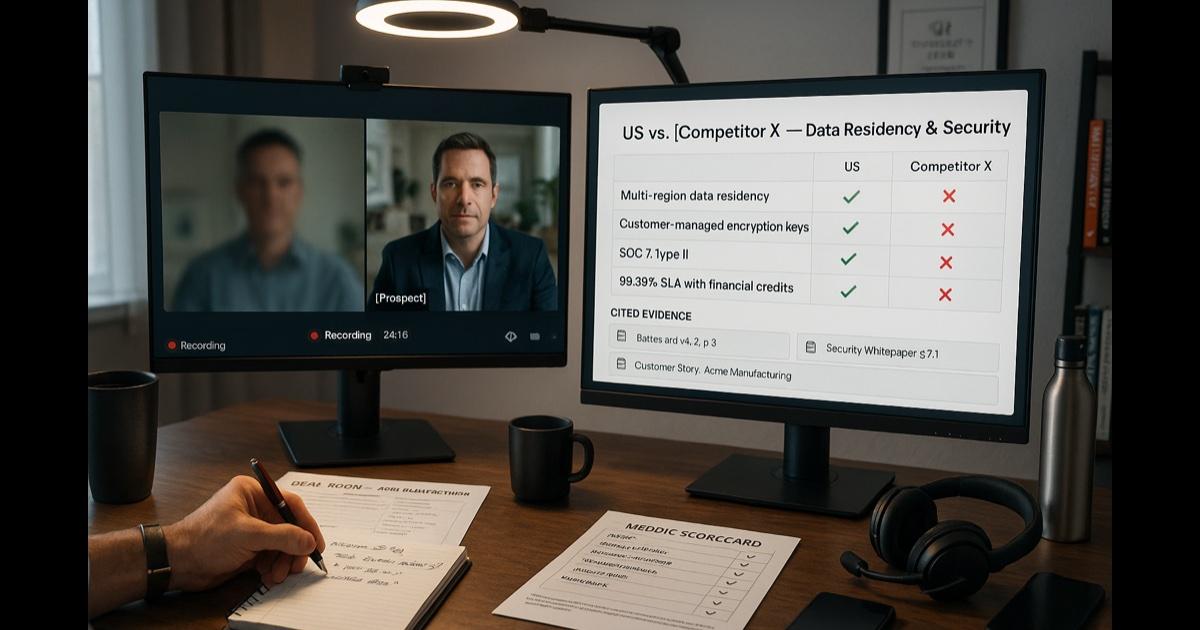
It's 2:14 PM on a Thursday. You're on a discovery call with a buyer who actually has budget. The energy is good. You've nailed the qualification. The use case is real.
Then they ask: "How are you different from [Competitor X]?"
You know there's a battlecard. You wrote part of it. It's in a Notion page somewhere. There's also a more recent one your sales engineer made for the FedRAMP angle that has the exact comparison you need on data residency. There's a Slack thread from last quarter where the VP of Product clarified the API rate-limit comparison once and for all. There's a Gong call from October where another rep handled this exact objection beautifully.
All of this lives in twelve different places. None of which you can navigate to in the next four seconds without looking like you're navigating to twelve different places.
So you say: "Great question — there are a few areas where we really differentiate, but the biggest one is..." and you ad-lib something that's mostly true. The energy of the call drops half a notch. They're not sure if you knew or you're guessing. You're not sure either.
Every rep has had this Thursday. The information exists. It's just not where you need it, when you need it.
Here is what actually works.
The move: stop memorizing, start querying
The mistake most reps make is trying to internalize the entire enablement library. You attended the kickoff. You sat through the battlecard rollout. You took notes during the win/loss review. You read the new product launch deck. And when the question comes mid-call, you can recall about 30% of any of it under pressure.
That's not a memory problem. That's a retrieval-system problem. The fix is not "study harder." The fix is putting your enablement library somewhere you can chat with your product docs and ask across the files in plain English in three seconds while a buyer is talking.
The playbook
Week one: upload the entire enablement shelf (one-time, 30 min)
Open CorpGPT. Drop in:
- All current battlecards — by competitor, by industry, by use case.
- Product sheets and one-pagers — the latest version, not the 2023 one that's still in three slide decks.
- The pitch deck and demo script.
- ROI calculator narratives — the words you'd say to defend the number.
- Customer case studies and reference accounts — by industry and use case.
- Win/loss memos — sanitized.
- Pricing and packaging guides — the approved talk track, not just the price grid.
- Security and compliance summaries — SOC 2, GDPR, HIPAA, FedRAMP whatever applies.
- Past Gong / Chorus call transcripts of objection handling done well, if your company shares them.
- The "objection handling FAQ" that lives in three different documents — consolidated here.
Thirty minutes. Your scattered enablement library is now one searchable place.
During the call: ask Nova in three seconds
The buyer asks the question. You acknowledge it: "Great question — let me make sure I give you the most current view." That sentence buys you four seconds, which is plenty.
Open the Digital Assistant (Nova) sidebar. Type:
"How are we different from [Competitor X] on data residency? Pull from the most recent battlecard."
Three seconds. Cited answer. You read it like you knew it. You add the human texture — "...and the reason that matters for your team is..." — and that's where your value as a rep is, not in memorizing battlecard bullets.
The buyer never knows. The buyer wouldn't care if they did. You answered the question with current, accurate, cited information. That's the bar.
Right after the call: do the follow-up in five minutes
You used to send the follow-up email at 6 PM, after you ran out of energy to do it well, and it was always a generic recap.
Now: as soon as the call ends, drop the call recording or transcript (Live Recording or your Gong/Chorus export) into CorpGPT. Open Knowledge Studio. Generate:
- Follow-up email draft — recap of pain points, decision criteria you uncovered, agreed next steps, dates.
- MEDDIC / MEDDPICC scorecard — what you have, what's missing, who else needs to be involved.
- Mutual action plan — the two-column joint timeline you keep meaning to send.
- Internal call notes for your CRM — the structured version of "how did the call go?"
Five minutes. You review for accuracy and voice, edit anything that's off, send. You walked into your next call already done with the post-mortem of the previous one. Fridays don't dissolve into "catch up on call notes."
For deal-specific prep: build a deal Knowledge Base
Big deal coming up. Open a Knowledge Base folder for the account. Drop in:
- The discovery call transcripts.
- The 10-K or annual report (public companies).
- Their RFP and any procurement docs they've shared.
- LinkedIn profiles of the key buying-committee members (sanitized).
- Any internal memos or strategy docs you have on the account.
Before the next call, ask Nova:
- "What pain points has the champion mentioned across all three discovery calls?"
- "What objections has procurement raised, and how did we respond?"
- "What's the strongest customer reference for this industry?"
- "Pretend you are the CFO on the buying committee — what concerns will you have about pricing?"
You walk into the next call sounding like you've been thinking about their account all week. Because you have, but the prep takes minutes instead of an evening.
Run the rep-only morning routine (10 min)
Before your first call:
- Ask Nova: "What changed in the battlecards this week? What product updates went live? Any new compete intel from win/loss?"
- If anything new, generate a flashcard set with Knowledge Studio. Run through it on the way to your desk.
The kickoff your enablement team did six weeks ago that you didn't really retain? Now you retain it, in 90-second daily doses, against the actual library.
The features doing the work
Digital Assistant (Nova) — instant cited answers from the enablement library. The "battlecard in your pocket on every call." Three-second retrieval, no rehearsal.
Knowledge Studio — follow-up emails, MEDDIC scorecards, mutual action plans, deal one-pagers, internal CRM notes. Each output under 60 seconds, grounded in the call transcript and deal Knowledge Base.
Intelligent Search — find any prior win story, customer reference, or objection-handling note by intent. "The customer story where we replaced X for a healthcare manufacturer" — found.
My Tutor — when a major product update or competitive shift drops, run a 20-minute structured ramp on the new battlecard before your first call of the day. Private, fast, on the materials your team built.
Live Recording — record discovery and demo calls (with explicit consent and following your company's two-party-consent rules). Auto-transcription drives the follow-up workflow above.
Why this actually works
Three forces are doing the real work.
First, sales calls are real-time information retrieval. The reps who close more aren't memorizing more — they're retrieving more accurate, more current information faster. That's an interface problem, not a knowledge problem. Cited Q&A in three seconds is the right interface.
Second, citations make competitive language defensible. Your legal team would prefer you not free-styled on competitor comparisons. With cited answers, you're reading from the approved battlecard, which means you're saying what your company has agreed it's okay to say. That's better for everyone.
Third, the post-call workflow finally happens. Most reps know they should send the structured follow-up, update the MEDDIC scorecard, and put the call notes in the CRM. Most reps don't, because by Friday afternoon they're exhausted. When the post-call workflow takes five minutes instead of forty-five, it actually gets done — and pipeline hygiene goes from a quarterly fire drill to a daily habit.
What this can't do
Be honest about this.
CorpGPT does not sell the deal. It doesn't read the room. It doesn't know that the champion's boss skipped the last call and is signaling disengagement. It doesn't run the demo, push for next steps, negotiate on price, or close.
It also doesn't replace your sales enablement team or your sales engineering bench. The battlecards still need to be written by humans who know the product. The competitor research still needs to be sourced by humans who follow the market. CorpGPT is the retrieval layer on top of your team's work, not a replacement for the work.
And on competitive language: always verify against the cited source before you say it on a call. Battlecards age. Competitor pricing changes. Your team updates language. Don't say it because the AI surfaced it; say it because you read the source and confirmed it's still true.
The bottom line
Prospect asks: "How are you different from [Competitor]?" You. Completely. Don't blank.
Ask Nova. Read the cited answer. Add your human take. Send the follow-up in five minutes after the call. Walk into the next call done with the previous one.
Close deals. Hit quota. Do the touchdown dance later. Alone. (Nobody needs to see that.)
Open CorpGPT. Upload the enablement shelf. Take the next call.
Keep reading
- 200 Resumes. One Hour. — how recruiters surface signal from a 200-resume pile and walk into the hiring manager intake actually prepared.
- Answer Once. Help Forever. — how HR managers turn the handbook into a self-serve, cited-answer assistant and finally take a lunch break.
- Another Meeting to Recap the Last Meeting — how project managers record meetings and ship the summary, decisions, and action items in two minutes.
- Client Deck Tomorrow. It's 8 PM. — how consultants synthesize four reports into a draft deck and pressure-test the story before midnight.
- It's 9 PM and You're Not a Lawyer — how small business owners review vendor contracts, catch red flags, and sign smart without a legal team.
- 200-Page Contract at 4:45 on a Friday — how lawyers catch every trap in a weekend ambush.
- Tax Code Changed. Again. — how accountants translate new tax rules into client-ready answers with citations in seconds.
- Two Minutes Before the Client Call — how financial advisors sound sharp on every unscheduled portfolio call.
- Claim Denied. Find the Clause. — how insurance agents pinpoint the exact exclusion in an 80-page policy.
- Ten Minutes Between Sessions — how therapists keep their clinical library, CE, and psychoeducation handouts one prompt away.
- Beat the Binder: The Nurse's 12-Hour Shift Playbook — how nurses turn hospital formularies into instant cited answers at the bedside.
- Doctors: Stop Charting After Hours — how physicians finish documentation before lunch instead of after dinner.
- Answer 'Will I Qualify?' in Seconds — how mortgage brokers answer clients on the first call.
- Turn One Chapter Into a Week of Lessons — how teachers build a full week of materials from a single source chapter in one evening.
- Your Client Wants 30 Listings by Saturday — how real estate agents review 30 disclosure PDFs in one afternoon.
- Cram 400 Pages Before Morning — the student version of the same playbook.
- Brand Says Bold. Legal Says Careful. — how marketing managers ship campaigns on time with brand and legal both signed off.
- Seventeen Transcripts. One Deadline. — how writers turn a pile of interview transcripts into themes, pulled quotes, and a working outline.
- Ninety-Minute Interview. Show Notes by Tuesday. — how indie podcasters ship the entire post-production package from one upload.
- Sixty Videos In. Did I Already Post This? — how content creators turn their back catalog into a searchable content brain.
- Sixty Papers. One Lit Review. One Weekend. — how researchers turn a stack of PDFs into summaries, themes, citations, and gaps.
- Three Investor Meetings. Three Different Decks. — how founders tailor a pitch per investor.
- 47-Page Brief. Proposal Due Friday. — how freelancers turn dense briefs into proposals in hours.
- Your Kid Just Asked About Algebra. — how parents help with homework using the actual textbook.
- Medicare Sent a Letter. 12 Pages. Tiny Font. — how older adults turn any letter into a plain-English one-pager.
- See all use cases — sales reps, recruiters, HR managers, project managers, consultants, small business owners, therapists, nurses, doctors, insurance agents, advisors, accountants, lawyers, brokers, agents, teachers, students, and more.
- Plans & pricing — free tier included, no credit card required.