Academic·March 20, 2026
Sixty Papers. One Lit Review. One Weekend. The Researcher's Playbook.
TL;DR
60 papers, draft due Monday, zero chance of reading them all. Here's the researcher's playbook to turn PDFs into summaries, themes, citations, and gaps.
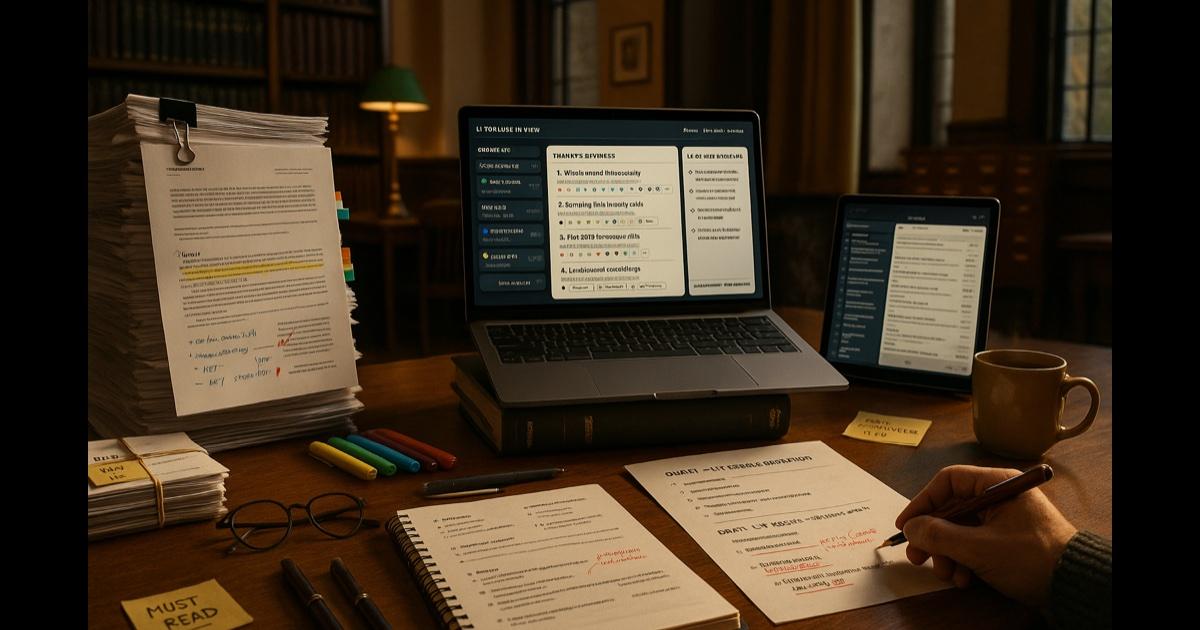
It's 11 on Friday night. The lit review draft is due Monday at 9. Your supervisor expects "thirty to fifty papers, minimum, actually integrated." On your desk — literally, physically on your desk — is a stack of printed papers you can measure in inches. In your Zotero library: sixty-three PDFs. You have opened fourteen of them. You have read, in full, four.
Your plan, formed Wednesday, was to do "three papers a night." That plan is dead. The plan now is: read the abstracts. Pray. Write something. Sleep Sunday afternoon. Present your weekend to the group meeting on Tuesday with the same face you use when someone asks how the dissertation is going.
Every field has its own version of this. Policy researcher staring at a pile of white papers. Medical reviewer with a PRISMA spreadsheet. Historian with primary sources. Social scientist with qualitative interview reports. The problem is always the same: the first pass through a large corpus is the most intellectually thankless part of research, and it eats the weekends that should be going to the actual thinking — the synthesis, the argument, the framework, the contribution.
This is a structured reading problem. Not a judgment problem. Your judgment is fine. Your judgment needs a better map to work on.
The move: turn the corpus into a searchable, structured map before you write
You are not going to skim your way to a great literature review. But you are also not going to close-read sixty papers in a weekend. What you can do — in a couple of hours — is turn the stack into a structured map: per-paper summaries, a thematic synthesis across them, points of agreement and contradiction, gaps in the literature, and a citation-ready bibliography.
Then you do the close-reading you actually need — on the twelve papers that turn out to matter most — and you write a draft grounded in the map, not drowning in the pile.
The work is still yours. The map just makes the work possible in the time you have.
The playbook
Friday night: load the corpus (45 min, once)
Open CorpGPT. Create a Knowledge Base: "Lit Review — [Project/Chapter Name]."
Drop in:
- Every PDF you have collected — even the ones you're unsure about. Wide net now, prune later.
- Your research question as a short document at the top ("What is this review actually about? What are the boundaries?").
- Any inclusion/exclusion criteria you've already written (especially for systematic reviews).
- The existing lit reviews or survey papers in your area — treat these as meta-data about the field.
- Your supervisor's prior papers on the topic. You are writing into their intellectual world; the tool should know it.
Forty-five minutes. One time per project. You now have a queryable corpus — your own field, in your own scope.
Friday night, part two: generate the per-paper cards (20 min)
Open Knowledge Studio and let the AI PDF summarizer summarize each paper into a paper card, in a consistent format:
- Full citation (ready to paste into your manager).
- Research question / hypothesis.
- Methodology (design, sample size, population, timeframe).
- Key findings (the actual claims, not the abstract's spin).
- Limitations (as stated by the authors and any obvious ones they don't mention).
- Relevance to your review — one or two sentences, with a confidence rating.
- Key quote with page number, for possible use in your draft.
Export the lot as a single document. Sixty papers, sixty cards, twenty minutes. This is the artifact that used to be your whole week of skimming.
Saturday morning: ask the corpus the real questions (1 hour)
Open Digital Assistant (Nova) against the Knowledge Base. Stop reading, start asking:
- "What are the dominant theoretical frameworks in this corpus? Which papers use each?"
- "What methodologies are dominant? Which are underrepresented given the research question?"
- "Which findings are broadly agreed on across papers? Which are contested? Cite the contradicting papers explicitly."
- "Which papers are cited heavily by others in this corpus? (Give me a rough citation-weight ranking.)"
- "What populations / geographies / time periods dominate this corpus? Which are underrepresented?"
- "What specific questions are raised in the 'future research' sections of these papers that have not been addressed by later work in the corpus?"
- "What's the strongest argument against my working hypothesis from this corpus? Cite the papers."
Every answer comes with citations to specific papers and pages. This is your field-level synthesis, and you did not have to read every paper end-to-end to get it. You still will read the important ones. But now you know which ones they are.
Saturday afternoon: the thematic map (30 min)
Ask Knowledge Studio for:
- A thematic synthesis — 6-10 themes that recur across the corpus, with 3-5 representative citations per theme and a one-paragraph summary of what the literature collectively says. If you think better visually, generate a mind map from a PDF or the whole corpus to map the literature as concepts and connections you can take in at a glance.
- A contradictions map — explicit pairs of papers that contradict each other on a claim, with the claim and citations.
- A gaps document — three to five specific, defensible gaps in the literature, each with cited evidence that the gap exists.
- A proposed review structure — three candidate organizing frameworks (by theme, by methodology, by chronology) with pros and cons of each for your specific research question.
Print the thematic map. Pin it to the wall next to your desk. Most people write lit reviews without ever having one.
Saturday evening: the twelve that matter (close-reading, your brain)
The map has told you which twelve papers carry the most weight. Not the tool's judgment — your judgment, informed by the map. Close-read those twelve. Pen in hand. Annotate. Argue with them. This is the actual research part of the weekend, and you're doing it on the specific twelve instead of drowning in sixty.
Sunday morning: draft the review (3-4 hours, your writing)
Open a blank document — but you're not starting cold. You have:
- The thematic map on the wall.
- The contradictions map.
- The gaps doc.
- Twelve papers you've actually read.
- Sixty paper cards to reference for supporting citations.
Ask Knowledge Studio for a skeleton draft — section headings, one-paragraph stubs per theme, a stub contradictions section, a stub gaps section, a proposed transition to your own contribution. Do not ship the stub. It is scaffolding. Write through it. Replace it with your argument, in your voice, with your framing.
Every time you make a claim, ask Nova to find the supporting and contradicting citations for this exact sentence. Each claim ends up citation-backed, automatically, with links to the specific paper. Drop them into your reference manager by the PDF name.
Four hours. Not ten.
Sunday afternoon: the verification pass (90 min)
Open the draft. Go sentence by sentence. For every citation, click through to the paper. Verify:
- The paper actually says what you're claiming it says.
- The page number is right.
- You haven't mis-summarized or over-claimed.
- You've read the full paper (or at least the relevant section) on the twelve that matter most; the rest are supporting citations, not load-bearing ones.
This is the step that cannot be skipped. The tool helps you get to the draft. It does not replace your responsibility to every claim you sign your name to.
Sunday 6 PM: send to your supervisor, go outside
The draft is cited, thematically organized, honest about gaps, and in your voice. Your supervisor will have notes. That's fine — they were always going to have notes. You've shipped a draft by the deadline instead of showing up Monday with "almost done" excuses for the third review in a row.
Beyond the one review
The compounding research corpus
Every paper you read into the Knowledge Base stays there. By year three of your PhD, you have a personal corpus of several hundred papers in your subfield — queryable, synthesized, and yours. When a visiting researcher asks what you work on, you can give them a five-minute answer with citations. When your advisor says "look at that 2021 methods paper," you find it in seconds.
Grant-writing is just lit-review-again
Every grant application needs the same synthesis: what's been done, what hasn't, what your contribution is. The same Knowledge Base produces a grant-ready background section in a fraction of the time. And Knowledge Studio will generate a draft aims section in your voice if you let it.
Preparing for your defense
Six weeks before your defense, ask Nova: "What are the five hardest questions a committee member could ask me about how my work connects to [each paper] in this corpus?" Get cited questions with cited counter-arguments. Practice against them. Walk in having already answered them once.
Staying current as the field moves
Every few weeks, new papers drop into the Knowledge Base. Ask Knowledge Studio: "What is new in the corpus since my last synthesis? Does any of it challenge or extend my existing draft?" You're not playing catch-up with the field; you're in a running conversation with it.
The features doing the work
Knowledge Studio — per-paper cards, thematic synthesis, contradictions maps, gaps documents, draft skeletons, grant-background drafts.
Digital Assistant (Nova) — cited cross-corpus questions. The colleague you wish you had for every question you're embarrassed to ask your advisor.
Intelligent Search — find the specific paper, method, population, or quote from a corpus of hundreds in seconds.
My Tutor — structured 20-minute primers when you're entering an adjacent subfield for the first time.
Live Recording — capture your advisor meetings and generate action-list recaps with citations back to the moment in the meeting where each came up.
Why this actually works
Three forces you can feel in your bones.
First, the lit review is the worst-structured, highest-stakes writing task in graduate work. Bad lit reviews kill dissertations. The reason bad lit reviews happen is not bad researchers; it is the ratio of corpus size to available time. Shift that ratio and the quality ceiling lifts immediately.
Second, the map is not a shortcut to the thinking. It is the scaffolding that makes the thinking possible. The best researchers all maintain these maps — they just used to do it in index cards, in three-ring binders, in their heads. The tool doesn't replace the habit. It makes the habit scale.
Third, most "AI hallucination" horror stories in academia come from people asking ungrounded models to write about a field. That is not what this is. This is: "synthesize the papers I gave you, with citations to the pages I can verify." The citations are the whole point. Without them, don't use the tool. With them, you're operating at a higher hygiene standard than half the lit reviews in your advisor's filing cabinet.
What this can't do
Be honest.
CorpGPT does not have the judgment to know which paper actually matters in your field vs. which is widely cited but wrong. It does not know which theoretical framework your committee prefers. It does not know the oral history — the "everybody knows X flamed out at that conference in 2019" — that shapes which citations are socially safe. It does not have the taste for argument structure that distinguishes a good review from a dense one. And it does not go sit with a paper for three hours and have an actual fight with it — which is the thing that produces original thought.
It is, again, a very good research assistant. A research assistant who has read every PDF you gave it, remembers it all, cites everything, and doesn't need Saturday off. You still have to think. The job of the tool is to give you back the time to do it.
And: check your journal's and institution's AI disclosure policies. Many require explicit methods-section disclosure when AI is used for synthesis or writing assistance. This is not onerous; it is the same honesty the tool is built to enable.
The bottom line
Sixty papers. One lit review. One weekend. The nervous breakdown is not on the schedule.
Open CorpGPT. Load the corpus. Get the map. Close-read the twelve that matter. Write your voice into the scaffolding. Ship the draft Sunday night.
Keep the weekend for actual humans.
Keep reading
- Sixty Videos In. Did I Already Post This? — how content creators turn their back catalog into a searchable content brain.
- Ninety-Minute Interview. Show Notes by Tuesday. — how indie podcasters ship the entire post-production package from one upload.
- Seventeen Transcripts. One Deadline. — how writers turn interview transcripts into themes, pulled quotes, and a working outline.
- Brand Says Bold. Legal Says Careful. — how marketing managers ship campaigns on time with brand and legal both signed off.
- How Are You Different From [Competitor]? — how sales reps get instant cited battlecard answers mid-call.
- 200 Resumes. One Hour. — how recruiters surface signal from a big applicant pile.
- Answer Once. Help Forever. — how HR managers turn the handbook into a self-serve assistant.
- Another Meeting to Recap the Last Meeting — how PMs ship meeting recaps in two minutes.
- Client Deck Tomorrow. It's 8 PM. — how consultants synthesize four reports into a draft deck before midnight.
- It's 9 PM and You're Not a Lawyer — how small business owners review vendor contracts.
- Ten Minutes Between Sessions — how therapists keep their clinical library one prompt away.
- Beat the Binder: The Nurse's 12-Hour Shift Playbook — how nurses turn formularies into instant answers.
- Claim Denied. Find the Clause. — how insurance agents pinpoint the exclusion.
- Two Minutes Before the Client Call — how financial advisors sound sharp on every call.
- Tax Code Changed. Again. — how accountants translate new tax rules.
- 200-Page Contract at 4:45 on a Friday — how lawyers catch every trap in a weekend ambush.
- Doctors: Stop Charting After Hours — how physicians finish documentation before lunch.
- Answer 'Will I Qualify?' in Seconds — how mortgage brokers answer clients on the first call.
- Turn One Chapter Into a Week of Lessons — how teachers build a full week of materials from one chapter.
- Your Client Wants 30 Listings by Saturday — how real estate agents review 30 disclosure PDFs.
- Cram 400 Pages Before Morning — the student version of the same playbook.
- Three Investor Meetings. Three Different Decks. — how founders tailor a pitch per investor.
- 47-Page Brief. Proposal Due Friday. — how freelancers turn dense briefs into proposals in hours.
- Your Kid Just Asked About Algebra. — how parents help with homework using the actual textbook.
- Medicare Sent a Letter. 12 Pages. Tiny Font. — how older adults turn any letter into a plain-English one-pager.
- See all use cases — researchers, content creators, podcasters, writers, marketers, sales, recruiters, HR, PMs, consultants, small business owners, therapists, nurses, doctors, insurance agents, advisors, accountants, lawyers, brokers, agents, teachers, students, and more.
- Plans & pricing — free tier included, no credit card required.