Work & Productivity·March 28, 2026
Doctors: Stop Charting After Hours. Here's the Playbook.
TL;DR
5:47 AM, thirty charts open, zero patients seen. Here's the physician's playbook to look up guidelines, transcribe consults, and finish notes before lunch.
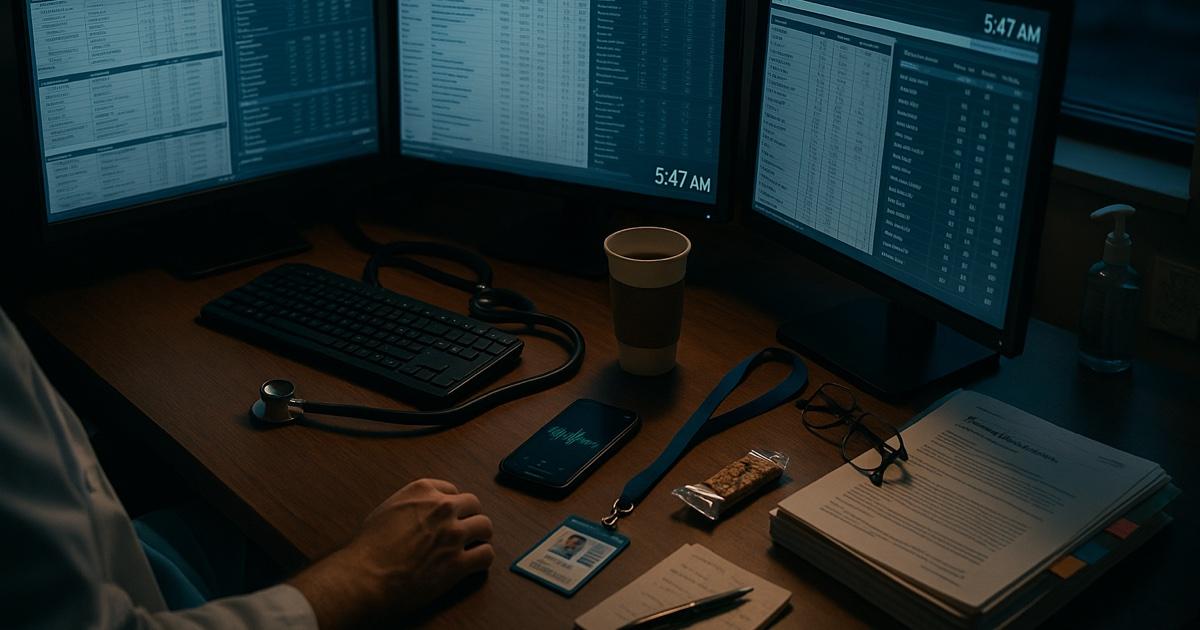
It's 5:47 AM. Your coffee went cold an hour ago. You have thirty charts open on three monitors and you haven't seen a single patient yet.
This is your morning. Not the worst one. Just a regular Tuesday.
By the time you do see your first patient, at seven, you're already behind. Every consult adds another note to write, another form to fill, another letter to draft. By six PM the patients are gone but you're still here, clicking through the same EHR you've been clicking through since before dawn. You do this again tomorrow.
Doctors don't burn out from medicine. They burn out from paperwork. Two hours of charting for every one hour of patient care. That's the ratio the AMA keeps measuring and nobody keeps fixing.
Here's what actually fixes it, starting today.
The core move: stop typing what you could be speaking
The bottleneck is not the medicine. You know the medicine. The bottleneck is the documentation layer between you and the patient. The charting. The guideline lookups. The prior auth letters that nobody reads but everybody requires.
You can't eliminate the documentation. But you can stop doing it by hand. Record the consult. Dictate the note. Let the guidelines answer your question instead of making you find the page.
The playbook
Once: upload your clinical stack (10 min, one time)
Open CorpGPT. Drop in every clinical guideline you actually reference. The big ones: AHA, ACC, ACR, ADA, IDSA, your hospital's internal protocols, your favorite specialty references. Prior auth templates. Discharge summary templates. Referral letter formats.
This is a one-time setup. Ten minutes. From here on, every guideline question you'll ever have lives in one place.
6:00 AM. Guideline lookup in seconds
Your first patient today has an atypical presentation. You need to check the current treatment protocol. Normally you'd open the PDF, search for a keyword, scroll past forty irrelevant results, find the section, read three pages of context to confirm the criteria.
Instead, type into CorpGPT: "Does a patient with X, Y, and Z qualify for the new biologic under the 2025 ACR criteria?"
Ten seconds. Answer with the exact page number and section. Cited. You verify it in one glance. Done.
This is not a guess. It's not a summary of something it found on the internet. It's pulled directly from the guideline you uploaded, with the citation so you can check it yourself.
7:00 AM–12:00 PM. Record every consult
Walk into the exam room. Tap record on your phone. Put it in your coat pocket.
Talk to your patient. Listen to your patient. No laptop between you. No screen to stare at while they're telling you what's wrong.
Walk out. The transcript is already there. Every word, timestamped.
Between rooms, pull out your phone and dictate your clinical note. "Assessment: 67-year-old male presenting with..." The transcript builds in real-time as you walk.
You just documented the consult in the hallway instead of at 8 PM.
12:00 PM. Batch the admin stack
Lunch. You have four discharge summaries, two referral letters, and a prior auth.
Feed the consult transcripts into CorpGPT. Ask it to draft the discharge summary using your template. It pulls the key findings, medications, follow-up instructions — all from the transcript of what you actually said during the consult.
Do the same for referral letters. Same for the prior auth. Each one takes sixty seconds instead of fifteen minutes.
Review each draft before it goes into the EHR. You're the physician. You sign it. But the first draft, the one that takes all the time, is done.
1:00 PM. You're caught up
Your afternoon patients start at 1:30. Your charts from this morning are closed. Your discharge stack is sent. Your referral letters are in the outbox.
This used to happen at 7 PM. Or 9 PM. Or not at all, and you'd come in Saturday to catch up.
The features doing the work
Intelligent Search — plain-English questions against your uploaded clinical guidelines. Cited answers with page numbers. No more keyword-searching through 800-page PDFs.
Live Recording — one-tap audio recording with real-time transcription. Works in the exam room, in the hallway, in the car on the way home. The transcript is yours, on your device.
Knowledge Studio — upload consult transcripts and ask CorpGPT to generate structured outputs: discharge summaries, referral letters, prior auth justifications, patient education handouts. All grounded in what you actually said and documented.
Why this actually works
Three forces are doing the real work.
First, dictation beats typing. You can speak four times faster than you can type. The hallway between rooms is dead time right now. With live recording, it becomes documentation time. The note writes itself while you walk.
Second, guideline lookup becomes a conversation. You stopped flipping pages. You ask a question. You get a cited answer. The cognitive load drops from "find the rule" to "apply the rule."
Third, templates plus transcripts equals first drafts. The discharge summary, the referral letter, the prior auth — they all follow a pattern. CorpGPT knows the pattern because you uploaded the template. It knows the content because you recorded the consult. Combining the two is what used to take fifteen minutes and now takes one.
What this can't do
Be honest about this.
CorpGPT does not make clinical decisions. It does not diagnose. It does not prescribe. It does not replace your judgment, your training, or your relationship with the patient.
What it replaces is the mechanical layer. The typing. The searching. The formatting. The two hours of after-hours charting that made you a doctor who goes home late instead of a doctor who goes home.
Every output should be reviewed before it enters the EHR. You are the physician. You sign it. The tool handles the first draft. You handle the medicine.
The bottom line
Two hours of charting for every hour of patient care. That's the number. That's what's burning out a generation of physicians.
You didn't go to medical school to fill out prior auth forms at 9 PM. You went to sit with the patient, listen, and help.
Upload your guidelines. Record your consults. Let the paperwork handle itself.
Open CorpGPT. Drop in your clinical stack. See your first patient without thirty charts already behind you.
Your patients get you. Not your paperwork.
Keep reading
- Cram 400 Pages Before Morning — the same playbook, but for a student buried in a textbook the night before an exam.
- Your Client Wants 30 Listings by Saturday — how real estate agents review 30 disclosure PDFs in one afternoon.
- Answer 'Will I Qualify?' in Seconds — how mortgage brokers answer clients on the first call.
- 200-Page Contract at 4:45 on a Friday — how lawyers catch every trap in a weekend ambush and still make it to dinner.
- Turn One Chapter Into a Week of Lessons — how teachers build a full week of materials from a single source chapter in one evening.
- Tax Code Changed. Again. — how accountants translate new tax rules into client-ready answers with citations in seconds.
- Two Minutes Before the Client Call — how financial advisors sound sharp on every unscheduled portfolio call with cited research.
- Claim Denied. Find the Clause. — how insurance agents pinpoint the exact exclusion in an 80-page policy and win the callback.
- Beat the Binder: The Nurse's 12-Hour Shift Playbook — how nurses turn hospital formularies and protocol binders into instant cited answers at the bedside.
- Ten Minutes Between Sessions — how therapists keep their clinical library, CE, and psychoeducation handouts one prompt away.
- It's 9 PM and You're Not a Lawyer — how small business owners review vendor contracts, catch red flags, and sign smart without a legal team.
- Client Deck Tomorrow. It's 8 PM. — how consultants synthesize four reports into a draft deck and pressure-test the story before midnight.
- Another Meeting to Recap the Last Meeting — how project managers record meetings and ship the summary, decisions, and action items in two minutes.
- Answer Once. Help Forever. — how HR managers turn the handbook into a self-serve, cited-answer assistant and finally take a lunch break.
- 200 Resumes. One Hour. — how recruiters surface signal from a 200-resume pile and walk into the hiring manager intake actually prepared.
- How Are You Different From [Competitor]? — how sales reps get instant cited battlecard answers mid-call and do the follow-up in five minutes.
- Brand Says Bold. Legal Says Careful. — how marketing managers ship campaigns on time with brand and legal both signed off.
- Seventeen Transcripts. One Deadline. — how writers turn a pile of interview transcripts into themes, pulled quotes, and a working outline.
- Ninety-Minute Interview. Show Notes by Tuesday. — how indie podcasters ship the entire post-production package from one upload.
- Sixty Videos In. Did I Already Post This? — how content creators turn their back catalog into a searchable content brain.
- Sixty Papers. One Lit Review. One Weekend. — how researchers turn a stack of PDFs into summaries, themes, citations, and gaps.
- Three Investor Meetings. Three Different Decks. — how founders tailor a pitch per investor.
- 47-Page Brief. Proposal Due Friday. — how freelancers turn dense briefs into proposals in hours.
- Your Kid Just Asked About Algebra. — how parents help with homework using the actual textbook.
- Medicare Sent a Letter. 12 Pages. Tiny Font. — how older adults turn any letter into a plain-English one-pager.
- AI meeting transcription — record or dictate, get the transcript and structured summary in minutes.
- See all use cases — doctors, lawyers, teachers, students, brokers, agents, and more.
- Plans & pricing — free tier included, no credit card required.