Creative·January 27, 2026
Sixty Videos In. Did I Already Post This? The Content Creator's Playbook.
TL;DR
60 videos in. Did you already post this in 2023? Here's the content creator's playbook to turn your back catalog into a searchable content brain.
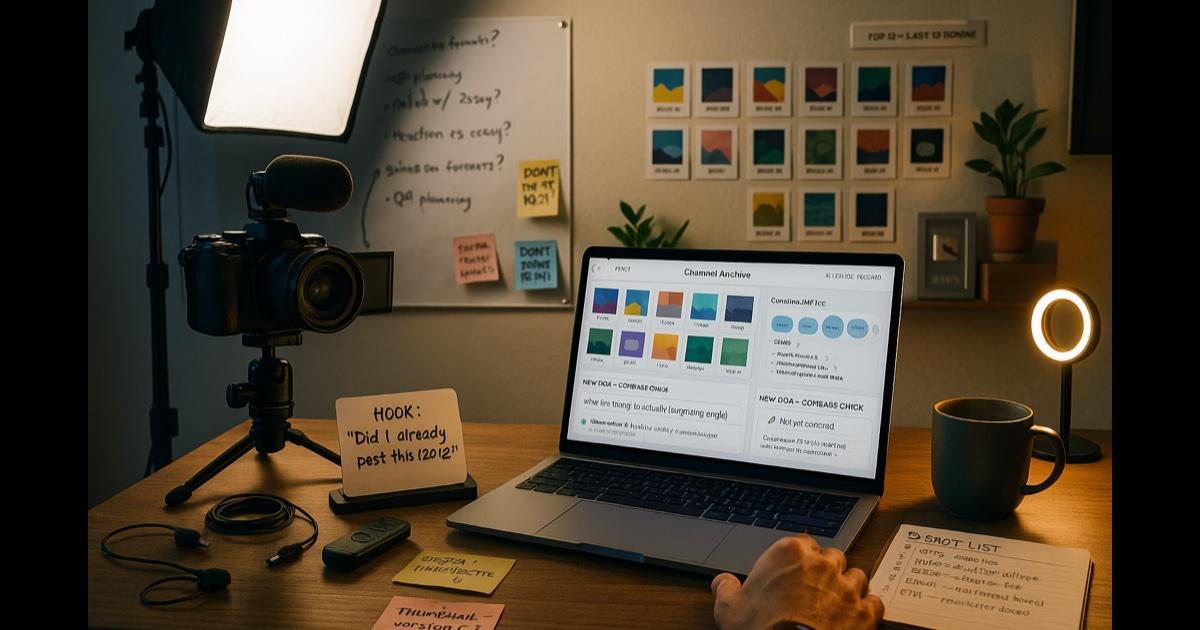
You sat down with your notebook, opened a fresh page, and wrote: "Idea: why the [thing] is actually [surprising angle]." It felt crisp. It felt hot. You already know how you'd open it. You can see the thumbnail.
Then a small voice, the one that lives behind your left ear: Didn't you already post this? Like, maybe in 2023?
You open your channel page. You scroll. You start clicking old video titles to check. You watch the first fifteen seconds of four videos from two years ago. You cannot remember. You close the tab. You open YouTube Studio's search. You try keywords. The search does not find the video. The search doesn't even agree with itself.
It's now been forty minutes. You haven't written a line of script. The idea, which was hot, has cooled. You switch to checking analytics on a video from last week. Thirty more minutes gone.
This is the content creator's specific trap. You don't have a content problem. You have a memory problem. Past you has already made sixty, eighty, two hundred videos. Current you has an idea. The bridge between them — "have I said this?" — doesn't exist anywhere searchable. So you either repeat yourself and hope nobody notices, or you abandon the idea and post something safer, or you lose the afternoon trying to remember.
The move: turn your entire back catalog into a searchable content brain
Upload every script, every transcript, every description, every pinned comment — the whole channel history — into one Knowledge Base. Now "have I covered this?" is a three-second question with a cited answer. And "what haven't I covered yet?" becomes a feature, not a mystery.
This doesn't replace your instincts. It protects them — so the thing you feel in your gut gets to be the thing you actually ship, instead of the thing you second-guess into oblivion.
The playbook
Saturday morning: load the channel (90 min, once)
Open CorpGPT. Create one Knowledge Base: "[Channel Name] — The Archive." Drop in everything:
- Every script you've written — even the messy ones, even the ones you stopped using halfway through.
- Every video transcript — download captions from YouTube Studio or run the video through Live Recording to get a clean transcript.
- Every video description — export them as a single CSV or text dump.
- Every video title and publish date — so cross-references have temporal context ("in 2023 you covered this differently").
- Your pinned comments and community posts — where a lot of your most-repeated explanations actually live.
- Your channel analytics summaries — which videos overperformed, which flopped. Let the archive know what worked.
- Any newsletters, blog posts, podcast appearances — you are your own cinematic universe. Load the whole thing.
Ninety minutes. One time. Now your last two or three years of work is a searchable corpus instead of a pile of files.
Saturday afternoon: diagnose the channel (30 min)
Open Knowledge Studio. Generate a topic map of the channel:
- Every distinct topic you've covered, with frequency counts.
- Topics covered shallowly (one video, one tangent) vs. deeply (a series, a recurring segment).
- Gaps — the topics that adjacent creators cover but you haven't.
- Clusters — what your channel is actually about, not what you think it's about.
- Evergreen vs. dated — which videos are still relevant, which are timestamped to 2022 and need refreshes.
Print it. Pin it to the wall next to your camera. This is the map of your channel. Most creators have never actually seen one.
Monday morning: the new idea (5 min)
You have the fresh idea. Before you script a word, ask Nova:
- "Have I covered anything related to [new idea topic]? List every video with the angle I took."
- "If I made this video, which prior videos would it complement or contradict?"
- "What's the strongest angle on this topic that I haven't taken in my past work?"
- "Which audience segment, based on my prior video comments, would most care about this?"
You get cited answers back in seconds. Three possibilities:
- You've already posted it. Honestly: happens more than you'd guess. You now know. Move on. No afternoon lost.
- You've touched it but shallow. The cited answer tells you exactly which prior video to reference, tease, or link in the description — the new video becomes a natural sequel, not an accidental repeat.
- It's genuinely new for your channel. You now have clearance to script with confidence, plus a fresh-angle suggestion grounded in what makes your channel distinct.
Five minutes. The forty-minute rabbit hole is gone.
Monday: script the video (2-3 hours, your voice)
Open a blank doc. But you're not starting cold. Ask Knowledge Studio:
- "Give me a script outline for a 12-minute video on [topic], in my voice, structured like my three best-performing videos on adjacent topics."
- "Pull three moments from my back catalog where I explained something related — I want to quote or callback to them." If a transcript isn't loaded yet, drop the link in and let the YouTube video summarizer condense each video so you can scan the angle in seconds instead of re-watching.
- "Draft three possible opens, three possible closes, and three alternate titles — all in the style of my recent top performers."
Edit aggressively. The draft is not the video. The draft is scaffolding. Your voice, your jokes, your visual ideas — still yours. But the blank-page tax is gone and the "is this already a thing on my channel?" tax is gone.
Filming day: post-record, ship the package (45 min)
You finish filming. Run the long audio through Live Recording — timestamped transcript comes back. Now Knowledge Studio produces:
- The video description with time stamps, chapter markers, links, and SEO keywords drawn from your top-performing descriptions.
- Five short-form clips — best moments with start/end timestamps for TikTok, Shorts, Reels.
- Three thumbnail-text candidates patterned on your best performers.
- A community post for the day of publish — the tease, in your voice.
- A newsletter blurb that links the video to a prior video that went deeper — building series retention.
- A pinned comment that seeds the conversation.
Each output is cited back to your own prior work, so you know it's your channel's tone, not a generic template.
Monthly: the content calendar (1 hour)
Once a month, ask Knowledge Studio: "Given my last 90 days of videos, the topic map, and my top-performing themes — propose 12 video ideas for next month, each with a premise, a hook, and a linked prior video I could reference or build on."
You get a month of ideas that fit your channel. You pick the four or six you actually want to make. You strike the ones that miss. Monthly planning goes from "stare at a whiteboard" to "edit a list."
Beyond the one channel
Build a creator brain that compounds
Every new video ships into the Knowledge Base. Every script, every transcript, every description. Year three of your channel, you're not starting over. You're standing on a corpus that gets smarter every week.
Three years in, a journalist emails: "Has your channel ever covered [topic]?" Intelligent Search finds the three videos, the pinned comment, the newsletter, in eight seconds. You respond in the same afternoon. That responsiveness is how the press mentions happen.
Use My Tutor to ramp on a new topic
You're doing a video on something you're not an expert in. Dump the five best source articles into a folder. My Tutor builds you a 20-minute structured lesson — key arguments, where experts disagree, the counterintuitive takes. You don't come off as an expert. You come off as a creator who actually read the material, which is rare enough to be a differentiator.
Use Nova to avoid the parasocial misstep
Before you post a sensitive opinion or a callout video, ask: "What have I said about [topic] in the past? Are there prior videos where I took a different position? Would posting this now create a contradiction?" Get the cited answer before you create the mess, not after the comment section finds it.
Turn the archive into a product
Four years in, your Knowledge Base is effectively a book, a course, a paid newsletter — take your pick. Knowledge Studio turns it into the outline of each. You own your corpus; now you own the leverage of it.
The features doing the work
Intelligent Search — the "have I said this?" check, answered by intent, not keyword.
Digital Assistant (Nova) — cited answers to every cross-channel question. Your producer, your fact-checker, your memory.
Knowledge Studio — topic maps, script outlines, descriptions, short-form clip recommendations, community posts, monthly content calendars — all grounded in your archive.
Live Recording — audio to clean, timestamped transcripts. Your channel's full spoken history, finally searchable.
My Tutor — 20-minute ramps on new topics before you film, so you walk in informed.
Why this actually works
Three forces are quietly at work.
First, the bottleneck on most creators past their first year is not idea generation. It's idea-to-ship friction. The blank page. The "have I said this?" spiral. The thumbnail decision paralysis. Every one of these friction points dissolves when you have a searchable, cited memory of your own work.
Second, consistency beats novelty on almost every platform. The creators who ship every week for five years win. The ones who burn out at video 40 don't. The single biggest determinant of that burnout is not motivation — it's the invisible overhead of running your own archive in your head. Offload the archive and the post-every-week math starts to work.
Third, your channel is a corpus of expertise even if you didn't plan it that way. Treating it as such — as a body of work rather than a stream of files — is the psychological shift that separates hobbyists from professionals. The tool is just what makes the shift cheap.
What this can't do
Be honest.
CorpGPT does not know what's funny in your voice. It does not know which editing choice hits. It does not have the taste to know which thumbnail pops on your specific audience. It does not have the instinct for when to post and when to hold. It does not care whether you show up, which is what actually determines whether you grow.
It is, again, a very good producer. A producer who remembers everything. That's the job.
And: creators owe their audiences honesty. If you use AI for research, scripting assistance, or clipping — say so where it's relevant. Transparency is one of the cheapest forms of trust you can build, and creators who trade it away for short-term polish usually pay for it twice.
The bottom line
Sixty videos in, the question isn't whether the idea is fresh. The question is whether you can tell, in five seconds, with the receipts.
Upload the back catalog. Get the topic map. Check the new idea against the archive. Script with confidence. Ship with the package pre-built. Repeat, every week, for five years.
Open CorpGPT. Load the archive. Post the thing.
Keep reading
- Ninety-Minute Interview. Show Notes by Tuesday. — how indie podcasters ship the entire post-production package from one upload.
- Seventeen Transcripts. One Deadline. — how writers turn interview transcripts into themes, pulled quotes, and a working outline.
- Brand Says Bold. Legal Says Careful. — how marketing managers ship campaigns on time with brand and legal both signed off.
- How Are You Different From [Competitor]? — how sales reps get instant cited battlecard answers mid-call.
- 200 Resumes. One Hour. — how recruiters surface signal from a big applicant pile.
- Answer Once. Help Forever. — how HR managers turn the handbook into a self-serve assistant.
- Another Meeting to Recap the Last Meeting — how PMs ship meeting recaps in two minutes.
- Client Deck Tomorrow. It's 8 PM. — how consultants synthesize four reports into a draft deck before midnight.
- It's 9 PM and You're Not a Lawyer — how small business owners review vendor contracts.
- Ten Minutes Between Sessions — how therapists keep their clinical library one prompt away.
- Beat the Binder: The Nurse's 12-Hour Shift Playbook — how nurses turn formularies into instant answers.
- Claim Denied. Find the Clause. — how insurance agents pinpoint the exclusion.
- Two Minutes Before the Client Call — how financial advisors sound sharp on every call.
- Tax Code Changed. Again. — how accountants translate new tax rules.
- 200-Page Contract at 4:45 on a Friday — how lawyers catch every trap in a weekend ambush.
- Doctors: Stop Charting After Hours — how physicians finish documentation before lunch.
- Answer 'Will I Qualify?' in Seconds — how mortgage brokers answer clients on the first call.
- Turn One Chapter Into a Week of Lessons — how teachers build a full week of materials from one chapter.
- Your Client Wants 30 Listings by Saturday — how real estate agents review 30 disclosure PDFs.
- Cram 400 Pages Before Morning — the student version of the same playbook.
- Sixty Papers. One Lit Review. One Weekend. — how researchers turn a stack of PDFs into summaries, themes, citations, and gaps.
- Three Investor Meetings. Three Different Decks. — how founders tailor a pitch per investor.
- 47-Page Brief. Proposal Due Friday. — how freelancers turn dense briefs into proposals in hours.
- Your Kid Just Asked About Algebra. — how parents help with homework using the actual textbook.
- Medicare Sent a Letter. 12 Pages. Tiny Font. — how older adults turn any letter into a plain-English one-pager.
- See all use cases — content creators, podcasters, writers, marketers, sales, recruiters, HR, PMs, consultants, small business owners, therapists, nurses, doctors, insurance agents, advisors, accountants, lawyers, brokers, agents, teachers, students, and more.
- Plans & pricing — free tier included, no credit card required.