Healthcare·March 3, 2026
Beat the Binder: The Nurse's 12-Hour Shift Playbook
TL;DR
New drug, patient on four others, twelve hours left on shift. Here's the nurse's playbook to turn unit policies and formularies into instant cited answers.
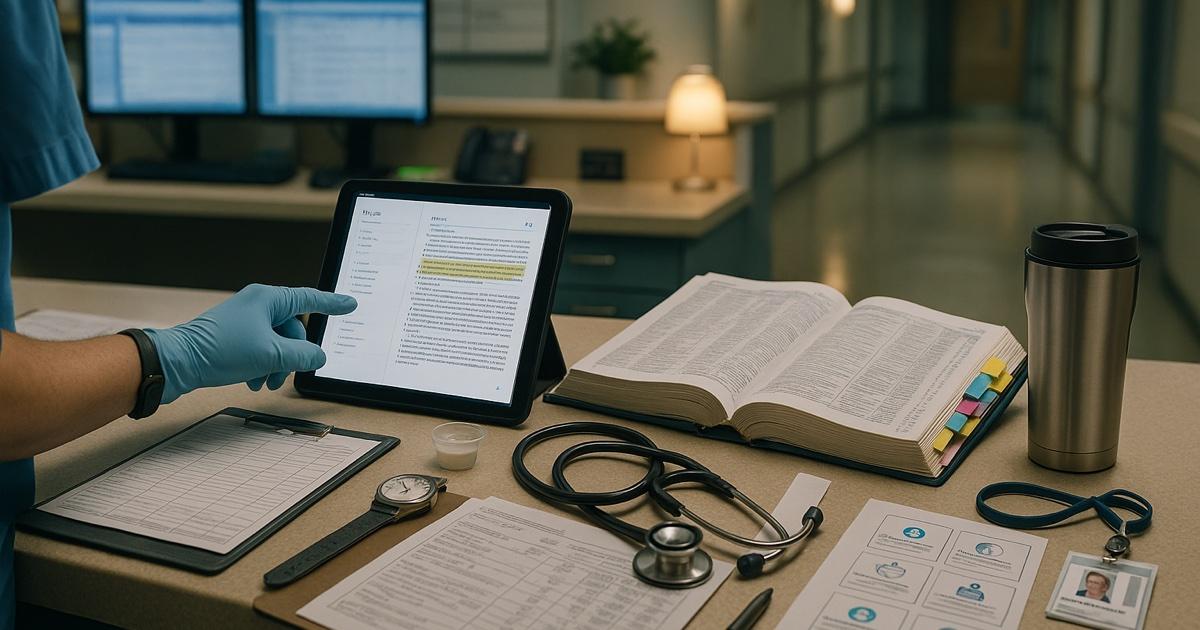
It's 7:03 AM. You just took report.
Your eight-bed assignment includes one post-op who's now on a new anticoagulant you haven't heard of, one elderly admit on four chronic meds the day shift didn't cross-check, one chest pain rule-out with a new IV drip you haven't titrated since last quarter, and a med-surg patient whose wound care protocol got updated in an email you may or may not have opened.
Before 8 AM you need to: verify orders, check the formulary on the new drug, find the updated wound care policy (was it in the intranet? the email? that binder? the other binder?), call the pharmacy if anything interacts, and try to remember what your patient's full name is so you don't say "hi sweetie" again.
The binder is on the shelf. It's 487 pages. You have forty seconds per patient for this entire lookup.
Here is what actually works.
The move: stop walking to the binder
The mistake every shift makes is treating the binder as the source of truth. It is the source of truth. It's also ten feet away, written in 9-point font, organized by a system that made sense to whoever put it together in 2014, and has probably been updated at least twice since you last looked inside.
Keep the binder. Keep the formulary. Keep the P&P manual. Just stop walking to them.
Upload them once. Then ask the binder a question instead of flipping through it — plain English in, page number, exact paragraph, and cross-reference out in seconds, right at the bedside.
The playbook
Week one: upload the shelf (one-time, 30 min)
When you have a quiet moment (you won't — but at shift change on a slow day, or a lunch break), open CorpGPT and drop in:
- The unit formulary or drug guide.
- The P&P binder (policies and procedures).
- Your hospital's clinical protocols (sepsis, stroke, code, DKA — whichever are in your practice).
- Patient education handouts (the ones the unit actually uses, not the ones from 2010).
- Any recent email updates from nursing administration that changed a protocol.
- Your preceptor notes or orientation binder, if you still have them.
One-time effort. Thirty minutes. After this, the entire reference shelf goes with you on a tablet or phone.
During the shift: ask at the bedside
Report says your patient just got ordered apixaban. You already know your other patient is on warfarin — wait, different patient. Still, you're not sure about this one. Open the Digital Assistant (Nova) on your tablet. Type:
"Apixaban — standard dose, renal dosing adjustment, contraindications, and any interaction with amiodarone or metoprolol."
Ten seconds. Cited answer from your hospital's formulary, with the exact page. You skim the citation, verify the dose against the order, and move on.
You did not open a binder. You did not walk to the med room computer. You did not page pharmacy (yet — if something is off, now you have a specific question to ask).
For the new protocol email: actually read it
The one that came in last Tuesday about updated wound care for stage-3 pressure injuries. You didn't have time then. You need it now.
Upload the email attachment or PDF. Ask Nova:
- "What changed from the previous protocol?"
- "When does the new protocol take effect?"
- "Who does this apply to? Which wound types, which units?"
- "Are there any new supplies I need to request?"
- "Does this conflict with anything in the main P&P binder?"
Five minutes, five cited answers. You now know the new policy without having to read the 22-page PDF cover to cover during your shift.
For patient education: make it readable
Your patient is going home on a new inhaler, a new blood thinner, and a diabetic diet. Your hospital has handouts for all three. They are, uniformly, too long, written at a 12th-grade reading level, and printed in a font size that elderly patients can't read.
Open Knowledge Studio. Feed it the three handouts. Ask for:
- A combined one-page summary at a 6th-grade reading level.
- A "what to watch for" list — signs they should call their provider.
- A translated version in their preferred language (if you have that content approved in your language bank).
- An infographic of the inhaler technique in six simple steps.
Fifteen minutes. Discharge teaching stops being "here's a stack of papers" and starts being "here's one page that covers the three things that will land you back in the ED."
For the unit: make the library shared
If your manager and charge nurses upload everyone's common references into a shared Knowledge Base folder ("Med-Surg Night Shift Reference"), every nurse on the unit works from the same library. New hires stop chasing binders. Float nurses orient in minutes instead of hours. The updated policy is in the library the same day it goes out in an email.
The binder is still there. Policy still owns it. But the binder stops being a daily workflow bottleneck.
The features doing the work
Digital Assistant (Nova) — plain-English Q&A over your unit's formulary, protocols, and policies with citations. Every answer points to the exact page in a document you uploaded, so you can verify before you act.
Knowledge Studio — 33 outputs from one source, each under 60 seconds. Plain-English patient education summaries, discharge teaching one-pagers, inhaler infographics, medication info sheets.
Intelligent Search — find a policy you remember reading once, six months ago, by intent. "The one about IV restart after infiltrate — had a flowchart" → found.
My Tutor — a short tutoring session on a new protocol you have to learn before tomorrow's shift. Twenty minutes. Private. Structured. You learn it the way you used to learn during orientation.
Live Recording — record a precepting or in-service session (with consent and facility approval). Transcribed automatically. The clinical educator's one-time talk is now searchable forever.
Why this actually works
Three forces are doing the real work.
First, your reference materials stop being trapped on shelves. The binder is the system of record. Great. But the binder shouldn't also be the system of daily lookup. Uploading it once makes the same information answerable in seconds, at the bedside, with citations.
Second, plain-English beats Ctrl-F. You don't think "placed-in-service" or "max dose unadjusted for CrCl." You think "can my patient get this?" The tool bridges your clinical question and the binder's technical language in one prompt.
Third, your unit's knowledge compounds. Every updated protocol, every P&P change, every new patient handout — as long as they go into the same library, the team gets smarter together. The nurse orienting tomorrow has what the charge nurse knew last year.
What this can't do
Be honest about this. Nursing is safety-critical, and you are the last line of defense before the patient.
CorpGPT does not diagnose. It does not order medications. It does not adjust doses, administer meds, or assess a patient. It does not replace pharmacy review of high-risk or high-alert medications. It does not replace the clinical decision-support in your EHR. It does not replace calling the MD.
What it does is collapse the search time between "I need to know X" and "my facility's approved answer to X." The lookup, the patient teaching prep, the new-protocol onboarding — that's grunt work. The clinical judgment, the assessment, the administration — that's always, always you.
Also: follow your facility's policies on AI, HIPAA, and PHI. Don't upload anything with patient identifiers unless your facility has explicitly approved a workflow for it.
The bottom line
Twelve-hour shift. Eight patients. Fourteen meds. Three protocols you need to double-check. One binder that's not going to read itself.
Ask CorpGPT. Get the page. Cross-check the interaction. Call pharmacy with a specific question, not a vague one. Walk into the room ready instead of searching.
Safe patient. Calm shift. Beat the binder. Keep your license.
Open CorpGPT. Upload the shelf. Take the next patient.
Keep reading
- Doctors: Stop Charting After Hours — how physicians finish documentation before lunch instead of after dinner.
- Claim Denied. Find the Clause. — how insurance agents pinpoint the exact exclusion in an 80-page policy and win the callback.
- Two Minutes Before the Client Call — how financial advisors sound sharp on every unscheduled portfolio call with cited research.
- Tax Code Changed. Again. — how accountants translate new tax rules into client-ready answers with citations in seconds.
- 200-Page Contract at 4:45 on a Friday — how lawyers catch every trap in a weekend ambush and still make it to dinner.
- Answer 'Will I Qualify?' in Seconds — how mortgage brokers answer clients on the first call.
- Turn One Chapter Into a Week of Lessons — how teachers build a full week of materials from a single source chapter in one evening.
- Your Client Wants 30 Listings by Saturday — how real estate agents review 30 disclosure PDFs in one afternoon.
- Cram 400 Pages Before Morning — the student side of the same playbook, the night before an exam.
- Ten Minutes Between Sessions — how therapists keep their clinical library, CE, and psychoeducation handouts one prompt away.
- It's 9 PM and You're Not a Lawyer — how small business owners review vendor contracts, catch red flags, and sign smart without a legal team.
- Client Deck Tomorrow. It's 8 PM. — how consultants synthesize four reports into a draft deck and pressure-test the story before midnight.
- Another Meeting to Recap the Last Meeting — how project managers record meetings and ship the summary, decisions, and action items in two minutes.
- Answer Once. Help Forever. — how HR managers turn the handbook into a self-serve, cited-answer assistant and finally take a lunch break.
- 200 Resumes. One Hour. — how recruiters surface signal from a 200-resume pile and walk into the hiring manager intake actually prepared.
- How Are You Different From [Competitor]? — how sales reps get instant cited battlecard answers mid-call and do the follow-up in five minutes.
- Brand Says Bold. Legal Says Careful. — how marketing managers ship campaigns on time with brand and legal both signed off.
- Seventeen Transcripts. One Deadline. — how writers turn a pile of interview transcripts into themes, pulled quotes, and a working outline.
- Ninety-Minute Interview. Show Notes by Tuesday. — how indie podcasters ship the entire post-production package from one upload.
- Sixty Videos In. Did I Already Post This? — how content creators turn their back catalog into a searchable content brain.
- Sixty Papers. One Lit Review. One Weekend. — how researchers turn a stack of PDFs into summaries, themes, citations, and gaps.
- Three Investor Meetings. Three Different Decks. — how founders tailor a pitch per investor.
- 47-Page Brief. Proposal Due Friday. — how freelancers turn dense briefs into proposals in hours.
- Your Kid Just Asked About Algebra. — how parents help with homework using the actual textbook.
- Medicare Sent a Letter. 12 Pages. Tiny Font. — how older adults turn any letter into a plain-English one-pager.
- See all use cases — nurses, doctors, insurance agents, advisors, accountants, lawyers, brokers, agents, teachers, students, and more.
- Plans & pricing — free tier included, no credit card required.