Business·April 3, 2026
47-Page Brief. Proposal Due Friday. The Freelancer's Playbook.
TL;DR
New client. 47-page brief. Proposal due Friday. Here's the freelancer's playbook to turn a dense brief into a tailored, shipped proposal in hours, not days.
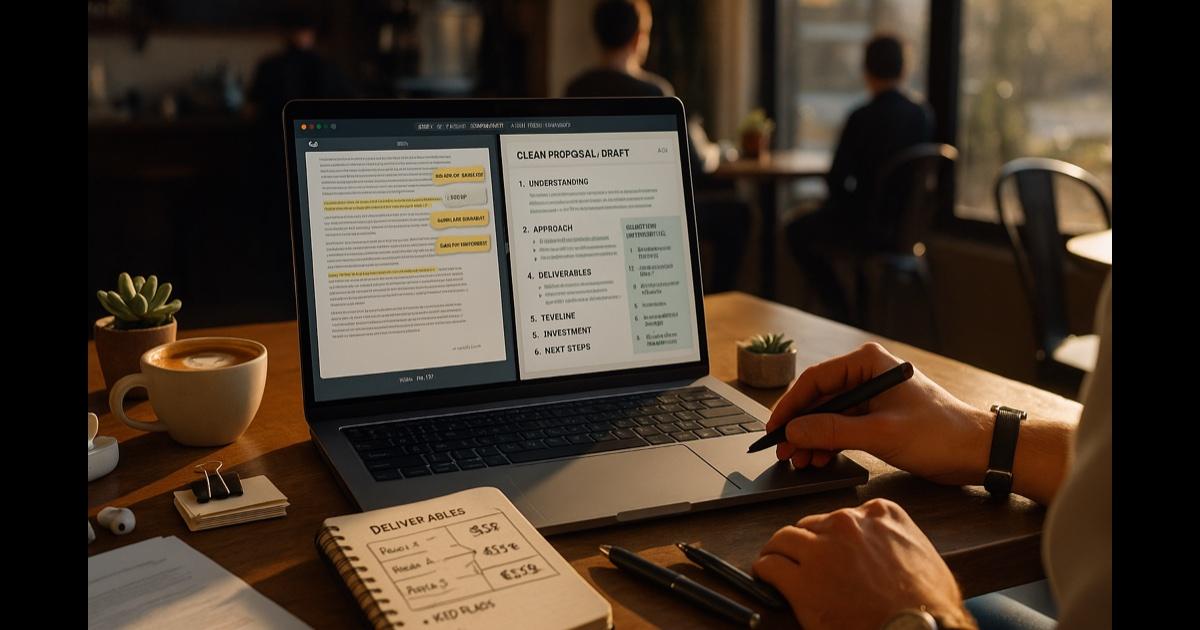
It's 3 PM Tuesday at your usual cafe. New prospect, referred by a past client. They sent a 47-page brief Monday night with the subject line "quick look?" You opened it at lunch. It is not, in fact, a quick look.
Page 1: a company overview. Page 7: a vague "success criteria." Page 14: an exhaustive list of "questions we'd want answered," most of which contradict the success criteria on page 7. Page 28: a timeline that starts next Monday. Page 41: a note that a competitor's previous contract "did not work out." Page 47: a polite request for your proposal by Friday EOD.
Your current reality: a Tuesday client call in ninety minutes, a Thursday deliverable for your biggest retainer, two kids at home, and a coffee that has been cold for some time. The old version of this story ends with you writing the proposal Friday at midnight, under-scoping the project out of exhaustion, winning it anyway, and spending the next six weeks regretting your own pricing.
The brief is not the problem. The problem is that reading 47 pages carefully enough to quote against them is a twelve-hour job, and you don't have twelve hours.
The move: turn the brief into a proposal before Thursday lunch
Drop the PDF in. Get a summary, the clarifying questions the client left out, a scoped deliverables list, a risk register, and a draft proposal — in an hour. Send the questions Wednesday morning. Get answers Wednesday afternoon. Ship the proposal Thursday before lunch. You are the freelancer who responded this week, not Friday at 11:58 PM.
The playbook
Tuesday afternoon: load the brief (10 min)
Open CorpGPT. Create a Knowledge Base: "[Prospect] — [Project]." Drop in:
- The 47-page brief.
- Any prior emails with the prospect.
- Your three most similar past proposals that you won.
- Your standard SOW template and rate card.
- The prospect's public website, About page, and recent blog/LinkedIn posts.
Ten minutes. Now the tool knows both the brief and you.
Tuesday evening: the brief diagnostic (30 min)
Open Knowledge Studio. Generate:
- A two-page brief summary — what they actually want, in plain language.
- A contradictions list — where the brief says two different things.
- A clarifying-questions list — the specific questions you need answered to quote responsibly (aim for 6-10 sharp questions, not 40 lazy ones).
- A deliverables breakdown — what you'd actually produce, with rough effort estimates.
- A risk register — specific things that will go wrong if the client doesn't clarify them up front.
- A red-flag note — anything in the brief that reads like scope creep bait, budget misalignment, or prior-contractor trauma.
Thirty minutes of focused work. This is what normally takes an entire afternoon of highlighter-and-sigh.
Wednesday 9 AM: send the clarifying questions
Do not write a proposal yet. Send the 6-10 clarifying questions. Short, professional, numbered, with context per question. Frame it as "so I can get you a proposal that's actually useful, a few quick questions first." Clients love this. It signals care. It surfaces the unspoken budget. It filters out tire-kickers. And it moves them to respond faster than your competitors who are still reading page 14.
Wednesday afternoon: draft the proposal (90 min)
Answers come back. Ask Knowledge Studio to generate a draft proposal using:
- Your three prior winning proposals as voice and structure references.
- The brief + the clarifying answers as scope.
- The SOW template as format.
Output: a draft with your positioning, your scope, your deliverables, your assumptions, your risk notes, your pricing placeholders, and your call-to-action.
You do not ship the draft. You edit it into your voice, delete the fluff, sharpen the value prop, and — critically — set the price yourself based on value and calendar, not on the tool's hour estimate.
Thursday morning: the pressure-test (30 min)
Before you send, ask Nova:
- "What's the weakest part of this proposal from the client's perspective?"
- "What's the single line a competitor would use to beat me on this deal?"
- "Where am I under-scoped? Where am I over-scoped?"
- "If I were the client reading this, what objection would I have?"
Fix the three things that come back. Send it.
Thursday lunch: proposal is out
You have responded in three days, not six. You have shown up with clarifying questions (a signal of craft). You have sent a proposal that reads specific, not generic. You are in the top 10% of responses this prospect will see.
Now go do the Thursday deliverable.
Friday: kickoff call prep (15 min)
If they want to meet Friday to walk through the proposal, ask Nova: "Given this prospect's brief, their company, and their public posture, what are the five hardest questions they'll ask me on Friday?" Draft one-paragraph answers. You walk in prepared.
Beyond the one proposal
Your proposal archive compounds
Every proposal — won or lost — goes into a separate "Proposal Archive" Knowledge Base. Year three, you are not writing from scratch anymore. You are editing what already worked.
Client onboarding, in one move
Once the SOW is signed, ask Knowledge Studio to generate a kickoff agenda, a project plan skeleton, a communication cadence doc, and a risk/change-order template — all in your voice. You look organized because you are.
Weekly status updates your clients actually read
Feed your weekly work into the KB. Knowledge Studio writes your Friday client update — specific, cited, short. Retention clients stay retention clients because they feel informed.
Scope-creep defense
When the client asks for "just one more thing" in week three, ask Nova: "Is this in the SOW? If not, what's the smallest fair change order?" You have a cited answer in ten seconds, not a week of resentment.
The quarterly self-review
Every quarter, ask Nova: "Across my last 10 proposals, which patterns correlate with wins vs. losses? What clients match my best outcomes? Which projects should I say no to next quarter?" Running your own book better is how freelancers get to the point where they can charge more and work less.
The features doing the work
Knowledge Studio — brief diagnostics, clarifying questions, draft proposals, SOWs, kickoff packages, weekly updates.
Digital Assistant (Nova) — pressure-testing, cross-proposal pattern recognition, scope-creep defense.
Intelligent Search — find the prior proposal, the prior clarification, the rate that worked.
Live Recording — prospect calls → action-list recaps and follow-up drafts the same hour.
What this can't do
It does not know which prospect is going to ghost you. It does not know when your gut is telling you the client is trouble — listen to your gut; it is usually right. It does not negotiate your rate; you negotiate your rate. It does not do the thing you were hired for. It helps you get hired in the first place faster, fairer, and for more.
The bottom line
New client. 47-page brief. Proposal due Friday. Coffee cold — fine, that part is on you.
Respond in hours. Win the gig. Send the invoice. Live the dream. Mostly.
Open CorpGPT. Load the brief. Ship the proposal.
Keep reading
- Three Investor Meetings. Three Different Decks. — how founders tailor a pitch per investor.
- Sixty Papers. One Lit Review. One Weekend..
- Sixty Videos In. Did I Already Post This?.
- Ninety-Minute Interview. Show Notes by Tuesday..
- Seventeen Transcripts. One Deadline..
- Brand Says Bold. Legal Says Careful..
- How Are You Different From [Competitor]?.
- 200 Resumes. One Hour..
- Answer Once. Help Forever..
- Another Meeting to Recap the Last Meeting.
- Client Deck Tomorrow. It's 8 PM..
- It's 9 PM and You're Not a Lawyer.
- Ten Minutes Between Sessions.
- Beat the Binder: The Nurse's Playbook.
- Claim Denied. Find the Clause..
- Two Minutes Before the Client Call.
- Tax Code Changed. Again..
- 200-Page Contract at 4:45 on a Friday.
- Doctors: Stop Charting After Hours.
- Answer 'Will I Qualify?' in Seconds.
- Turn One Chapter Into a Week of Lessons.
- Your Client Wants 30 Listings by Saturday.
- Cram 400 Pages Before Morning.
- Chat with PDF — ask any brief questions and get answers cited to the page.
- See all use cases — freelancers, founders, researchers, and 23 more.
- Plans & pricing — free tier included.